
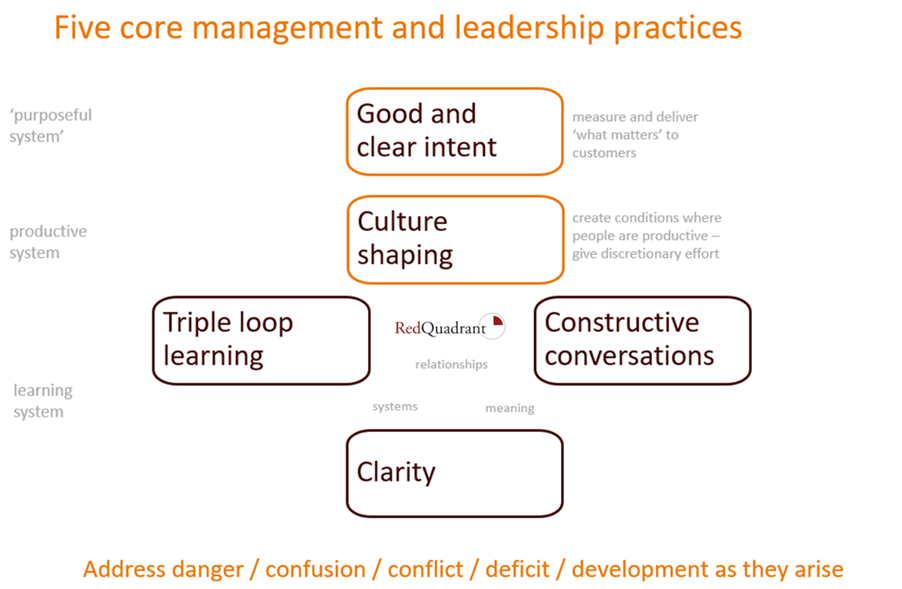
If your organisation isn’t practising – not preaching – honest conversation, clarity, learning, culture, and purpose… what exactly is it doing? https://www.linkedin.com/posts/antlerboy_agile-digitisation-productiveconversations-activity-7343179569169899520-Wm15 Have you seen these practices impact organisations, for better or worse? Which of these five core practices is most challenging in your organisation, and how does that show up in your daily work?
Too many change efforts collapse under the weight of their own contradictions. Rather than seek ‘simplicity on the far side of complexity’, leaders reach for silver bullets – reorgs, rebrands, the many waves of #agile, ‘#digitisation‘– and then act surprised when people don’t thrive, innovation stalls, and outcomes don’t shift. So what if we started in a different place?
The five core practices give us a way in.
Not a ‘model’, not a doctrine, but a discipline – for developing #productiveconversations, real #clarity, true #learning, intentional #culture, and shared #purpose. These aren’t soft skills – they’re hard practice.
Are you
– making an attempt at getting at shared truth, including emotions, reasoning, the unspoken?
– creating clarity of roles, tasks, programmes, projects?
– really learning on an ongoing basis?
– shaping a culture where people can give their best?
– focused on a good and clear intent?
Done right, they’re self-correcting. And done together, they make organisations more viable, more human, and more capable of acting on and within #complexity.
Think triple-loop learning. Think VSM meets Barry Oshry meets Sandra Janoff meets Chris Argyris. Think of an organisation where the work is the learning and the learning is the work. It’s not performance management, and it’s not even ‘telling it like it is’ – it’s practising our way into new realities.
Have you seen these practices impact organisations, for better or worse? Which of these five core practices is most challenging in your organisation, and how does that show up in your daily work?

 chosen path