We are delighted to share the news that there is now a Level 7 Systems Thinking Practitioner Apprenticeship available in England.
Systems thinking practice was developed specifically to address highly complex, adaptive, and dynamic situations. It helps you to model each situation as a system incorporating many different parts, dependencies and relationships. Systems thinking practitioners are uniquely equipped for achieving large-scale transformational change.
If you live in England, you can benefit from the scheme. The Apprenticeship is a two-and-a-half year, day release, post-graduate qualification with government funding of up to £18,000 per person. It is fully supported by expert tutors, comprehensive learning materials, and ongoing action learning.
This is a practice-based, portfolio assessed programme which draws on core systems approaches and practice skills. You’ll be supported in your job to actually put the learning to work right away, and you will be evaluated on how you incorporate your continual learning into your practice.
It’s been designed by practitioners for practitioners — the people who have not just read the books, but have written them. More importantly, these are people who have been there, done it, know about all (or at least most) of the pitfalls, and can guide you away from them.
The professional body for systems practice, SCiO, is providing world-class systems practitioner-tutors, and is supporting the curriculum development and overall approach of the programme. They are acting in collaboration with Cherith Simmons Learning and Development, who provide the apprenticeship. Further details are available here.
If you’re not in England, you can still sign up to individual modules here.
And if you are interested in developing your transformation skills, take a look at the RedQuadrant tool shed. This is a small group action learning journey with Benjamin Taylor, founder of the consultancy RedQuadrant, supported by 24 online modules covering all aspects of organisational transformation. Get a 20% discount by mentioning Enlightened Enterprise Academy.
Link Collection:
My Weekly Blog post:
In the quest for groundbreaking artificial intelligence, I can’t help but notice the neglect of mundane issues. Take my enduring woe with Hotmail’s spam filter—it persistently mislabels wanted emails, a glitch I’ve futilely reported. The problem extends to our business MS365 account, where even internal messages get ensnared. It’s a microcosm of innovation faltering at basics. From perpetually untied shoelaces to USB plugs defying the first two attempts, daily irritations persist. Touchscreens snub gloved hands, printers remain perennial foes, and voice recognition, though advancing, falters in practical scenarios. Despite a world fixated on groundbreaking advancements, these humdrum problems endure, perhaps overshadowed by the allure of grander innovations.
For those who ascribe “complex adaptive systems” to mathematicians and physicists at the *Santa Fe Institute* (founded in 1984) 2, it’s worth noting the 1968 article published by Walter F. Buckley.
Society as a Complex Adaptive System, Buckley (1968)Systems Thinkingsociologycomplex-adaptive-systemsAug 20201 / 1Aug 2020Aug 2020davidingAug ’20For those who ascribe “complex adaptive systems” to mathematicians and physicists at the *Santa Fe Institute* (founded in 1984) 2, it’s worth noting the 1968 article published by Walter F. Buckley.
“At the Relating Systems Thinking & Design symposium RSD12, Carine van Loon and I presented a new concept in systemic design, which we refer to as ‘systemic mirroring’: designing an object that provides system stakeholders with a different perspective on the system they are part of. It confronts them with their beliefs about the system and their role in it. We hope that such mirrors support stakeholders in redesigning the system from the inside out. We illustrate the concept with Carine’s graduation project in which she designed a children’s book that reflects the care system around parents with a child with special needs. You can watch our presentation here”
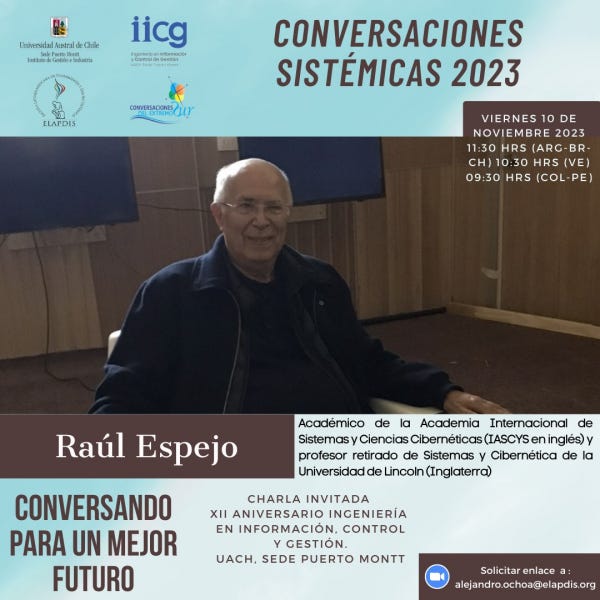
ELAPDIS (Latin American Society for Systems Thinking) with the assistance of Metaphorum are kindly inviting you to join Raul Espejo’s webinar ‘Talking for a better future’ (Conversando para un mejor futuro) which will happen on Friday, November the 10th, 2023, at 11:30 HRS (ARG-BR-CH) 10:30 HRS (VE); 09:30 HRS (COL-PE)14:30 pm (UK). The webinar will be in spanish. Those interested in attending please request the webinar link to Alejandro Ochoa at alejandro.ochoa@elapdis.org).
Metamodern Theory and Praxis is a new, peer-reviewed, anti-disciplinary, Open Access journal dedicated to bleeding-edge work in the Human Sciences (Humanities + Social Sciences) and focused on the unfolding paradigm(s) of metamodern theory and praxis.
Constellations Workshops 2023 & 2024 This newsletter brings you an overview of the current meus constellations workshops running in to 2024, facilitated by Ty Francis. All workshops advertised here are ‘in person’ events where Ty will be bringing his unique focus on both the personal development of practitioners with the business development we are entrusted to support and enable for ourselves and our organisational clients.Organisational Trauma & ConstellationsIt seems beyond doubt that an organisational culture can be traumatised as much as an individual. Yet what are the implications of this perspective for leaders, managers, coaches and consultants working within and for organisations? In this 2-day workshop we will explore the topic of Organisational Trauma through inputs on leading edge theory, exploration of case studies, group discussion and enquiry, and – importantly – through the medium of practical, experiential work with Organisational Constellations. For further information and to book your place click below. 2-Days in person in CardiffDates: 19th & 20th Nov 2023 Cost: £580Book your placeMoney ConstellationsThis workshop provides an opportunity to explore the hidden dynamics that might be affecting your relationship with money and financial success. There will be opportunities for personal enquiry into your relationship with money, using family and organisational constellations; as well as teaching inputs and exercises that will enable you to clarify areas of difficulty, entanglement and lack of flow regarding money. For further information and to book your place click below.1 Day in person in CardiffDate: 12th April 2024 Cost: £220Book your placePersonal ConstellationsNot a teaching seminar, but a 2-day ‘constellations clinic’ for people who want to explore what holds them back at work and in life more generally. Drawing on a unique mix of family and organisational constellations experience, Ty will share his own approach to ‘coaching constellations’ – creating opportunities for shifts of awareness that can be enriching and sometimes even transformational. For further information and to book your place click below.2 Days in person in CardiffDates: 23rd & 24th May 2024 Cost: £292Book your placeConstellations Learning CircleThis Learning Circle is intended as an annual event to provide experienced constellations practitioners with opportunities to develop their own ‘signature style’ and to improve and deepen their constellations practice in a safe and supportive environment. A focus on your own inner journey as a coach, manager, or other organisational practitioner is a central feature of the programme. Therefore, an openness to exploring your own life-themes (and a commitment to working compassionately with yourself and with others) is a pre-requisite of participation. For further information and to book your place click below.3 Days in person in CardiffDates: 4-6th Sept 2024 Cost: £950Book your placeLeading the workshopsTy Francis PhD Ty is an experienced OD practitioner who works with global corporations, Government Departments and Public Sector organisations. He has been practising and teaching Constellations for over 20 years and supervises coaches and consultants drawing on this approach. His Doctorate on Social Psychology focused on facilitating ‘breakthrough’. His practice is deeply informed by Gestalt, Systemic Constellations and the work of Presence taught by The Ridhwan School. Ty is passionate about the use of film to inspire personal, organisational and cultural transformation.
Presented by Paul Brest, Former Dean and Professor Emeritus (active), Stanford Law School
Moderated by David V. Johnson
Date Wednesday, December 6, 2023
Time 11 a.m.-12:30 p.m. PT / 2-3:30 p.m. ET
Social problems are complex, and creating effective solutions requires developing a skillset for identifying causal relationships and predicting consequences. On Dec 6, join SSIR Live! and Paul Brest, former dean and professor emeritus (active) of Stanford Law School, for a 90-minute webinar: Systems Thinking for Social Entrepreneurs, Philanthropists, and Policy Makers.
Systems thinking reveals the web of associations in which social problems reside. This webinar introduces the mindsets and skills for thinking about systems and learning to map them—essential knowledge for any social entrepreneur, philanthropist, policy maker, or citizen who wants to understand both the knowable and unintended consequences of efforts to solve any problem facing society.
In this 90-minute live program you will learn:
The basic concepts of systems thinking and systems mapping, and how they differ from stakeholder maps and theories of change
How to decide where to intervene to change a system
Why systems change is not necessarily the best strategy for solving social problems
How to construct systems maps using the free web-based tool Kumu
The importance and risks of mental models, and how to improve them
Don’t miss this opportunity to learn valuable skills that will help you better design and identify enduring solutions!
Speakers
Paul Brest Former Dean and Professor Emeritus (active), Stanford Law School
David V. Johnson Editor, Stanford Social Innovation Review (Moderator)
P.S. Away from your desk during this webinar? Registerand you can view a recording on-demand three hours after the live event ends and anytime over the next twelve months.
Join us for this panel “Systems And Complexity-informed Approaches To Evaluation: A Contribution To ‘Alternative Futures’ during the EES Online conference #EES23 on 15th November 2023!
This panel is hosted by the EES Thematic Working Group “Systems Approaches in Evaluation” (TWG 8). As the youngest TWG in the EES, we have been set up a year ago to help to boost the capacity of the community of evaluation practitioners to support the needed transformation of evaluation practice through more systemic and complexity-sensitive evaluation. Within a year of establishment, our membership has doubled to over 130 members. This rapid growth gives testimony to the growing interest in and relevance of systems- and complexity-informed approaches to evaluation. More information about the vision, mission and objectives of TWG8 is on this webpage: https://lnkd.in/eDJricDx.
In this panel discussion, we want to further build on previous discussions, such as this recent debate (summarized in this blog: https://lnkd.in/eSh8muzB), by bringing in additional perspectives and diverse voices, as part of the many important ongoing developments and discussions taking place in the evaluation field with respect to systems and complexity-informed evaluation.
This women panel will bring diverse voices, multiple perspectives and worldviews to the debate, with interest and experience of using and promoting systems approaches in their evaluation practice. Panelists will discuss what concrete and transformative contributions can be provided to ‘alternative futures’ at the intersection of systems approaches and evaluation. Each of the panelists will ask one key burning question related to this conference theme for discussion with the other panelists, and will contribute with their own perspective and experience. The burning questions discussed by the panel are guided by the overall conference theme, exploring what systems approaches DO, or COULD, contribute to this vision, and to change the way we work as evaluators, in practice. These personal ‘burning issues’ in relation to this overarching framing will give rise to reflexive conversations with fellow-panelists. Join us!
We are happy to extend an public invitation to join the international research team of the joint AHRC-DFG funded ‘Enacting Gregory Bateson’s Ecological Aesthetics in Architecture and Design’ research project, for an introduction to the thinking of the ecological anthropologist Gregory Bateson, and a presentation of one of the key research themes of this two year project: The Double Bind of Design.
The evening will include an introductory talk by Dr Jon Goodbun on the thinking of the ecological anthropologist Gregory Bateson, whose colourful practice moved from anthropological field work in the 30s, participation in the foundational Macy conferences on cybernetics in the 40s, working as an ethnologist with patients diagnosed as schizophrenics and their therapists at the Palo Alto VA hospital in the 50s, moving on to the study of animal and ecosystemic communication, learning and evolution in Hawaii in the 60s, and culminating in an ultimately unfinished but incredibly rich project to describe the onto-epistemologcial form and structure of both our fundamental socio-ecological existence, and the pathological ‘epistemological errors’ of western thought which – now amplified by capitalism and advanced technology – are unfolding violently through the wider web of life upon which we ultimately depend. He asked, as we must ask too: How can we approach the possibility of future human adaptation to, and care of, this now severely damaged ecological condition, given that so much of our fundamental thinking and practice around design and the possibility of planning is still so badly damaged? It might be that whatever we do, if based upon a narrow western forms of ‘conscious purpose’, will only make things worse?
Following the introductory talk, the wider international research team of this project will introduce themselves and some of their particular research questions and projects in relation to this three day workshop on ‘The Double Bind of Design’. The team includes the PIs from the two lead institutions: Sri Lankan academic Dr Dulmini Perera from the architectural history and theory department of Bauhaus University Weimar and Dr Ben Sweeting who runs the Radical Methodologies programme in the School of Architecture, University of Brighton. We are also joined by design theorist and designer Dr Joanna Boehnert, from Bath Spa University, and Professor Simon Sadler, art and architectural historian and Chair of the Department of Design at University of California Davis. Finally from Stuttgart University we have the bio-installation artist-architect Marie Davidova, and the two PhD researchers Stefanie Huthöfer and Claudia Valverdel.
Please sign up for the Wednesday 8th 6pm lecture here (online): Londoners: Come in person. Everyone else: watch on Zoom. Pls register here: https://lnkd.in/eYAppECU
CSS Webinar – Towards Regenerative Ecosystems: Evidence from Action Research on Water and Agricultural Systems
Show in My Time Zone
Abstract Over the past ten years, the Centre for All Interacting Evolving Systems Science (AIESS) has been a focus for transdisciplinary action research and government policy advice on regenerative ecosystems. This seminar will focus on the findings from transdisciplinary action research project on the five natural critical factors of agricultural production (water, soil, genetic stability, diversity, and ecology) which were triangulated with findings of case studies of farmers across India. The research found that the dynamic interactions among the critical factors of agricultural production aligned with nature triggered virtuous cycles of regeneration making the farm rich with water, soil, and highly productive. Biography (Amar KJR Nayak) Biography (Amar KJR Nayak) Over the last two decades, in addition to teaching Research Methodologies, Sustainability and Systems Science, Amar has been involved in numerous ecosystem based transdisciplinary Action Research projects focused on addressing complex problems and facilitating convergence in policy and practice. As the founder and chair of the Centre for All Interacting Evolving Systems Science (AIESS), Amar is interested in the ontology and epistemology of change (degenerative and regenerative) and has been an advisor, consultant, and a trainer to many institutions, including the Indian Government, State Governments, UN Agencies, For Profit as well as Not-for-Profit Organizations and Academic Institutions. At the Xavier Institute of Management, XIM University Bhubaneswar, he has been two-time Chair Professor of National Bank for Agriculture and Rural Development (NABARD) and a tenured Professor of Strategy.
CSS Webinar – Towards Regenerative Ecosystems: Evidence from Action Research on Water and Agricultural Systems
This is the public page for the ASC Working Group on ASC and Cybernetics Archives.
If you wish to join the working group please contact Peter Tuddenham.
This is the public page for the ASC Working Group on ASC and Cybernetics Archives.If you wish to join the working group please contact Peter Tuddenham.
On January 11 and 12, 2024, the Systems-Centered® Research and Training Institute (SCTRI) will host the first international, online conference focused on organization development applications of Systems-Centered Theory (SCT®)developed by Yvonne M. Agazarian.
In this experiential conference, expert organizational development consultants and their client partners will engage participants to explore how SCT methods create an experience of collaboration and belonging that leads to high performance.
A SYSTEMS-CENTERED® APPROACHONLINE ORGANIZATIONAL DEVELOPMENT CONFERENCEJanuary 11 and 12, 20249:00am – 2:00pm ET14:00 – 19:00 GMT15:00 – 20:00 CETREGISTER NOW LOGINJAN 11 & 12, 2024NO TRAVELBREAKOUT SESSIONSLEARN & CONNECTWelcomeOn January 11 and 12, 2024, the Systems-Centered® Research and Training Institute (SCTRI) will host the first international, online conference focused on organization development applications of Systems-Centered Theory (SCT®) developed by Yvonne M. Agazarian.In this experiential conference, expert organizational development consultants and their client partners will engage participants to explore how SCT methods create an experience of collaboration and belonging that leads to high performance.
The conclusion? Determinism and non-determinism are not properties of *systems* but properties of *models*. So it simply doesn’t make sense to ask “Is the universe deterministic?” or “Is quantum mechanics non-deterministic?” or even “Do humans have free will?” (7/8)
Sometimes it’s useful to model these things deterministically, sometimes it’s not. But never forget that these notions of determinism and non-determinism are human concepts that *we* have introduced through our choice of models. The universe, fundamentally, doesn’t care. (8/8)
Indika Rajapakse, Computational Medicine and Bioinformatics (Medical School); Mathematics (LSA); CSCS Affiliated Faculty Member
Talk will be recorded for later viewing. Coffee and snacks will be served.
Abstract: This talk will introduce Alan Turing’s work on morphogenesis and an extension by Stephen Smale. In current work, Stephen Smale and I are using a Turing-inspired system to study the dynamics of higher-order structures. I will discuss how this framework can guide construction of a digital twin in biomanufacturing.
Indika Rajapakse is a Professor of Computational Medicine and Bioinformatics (Medical School) and Professor of Mathematics (College of Literature, Science, and the Arts) at the University of Michigan, Ann Arbor. He is also a member of the Smale Institute and the Chief Scientific Officer and co-founder of iReprogram, Inc.
Presented By: The Center for the Study of Complex SystemsContact Organizers Flag As InappropriateCSCS Seminar | ‘The Turing System Indomitable’Indika Rajapakse, Computational Medicine and Bioinformatics (Medical School); Mathematics (LSA); CSCS Affiliated Faculty MemberTalk will be recorded for later viewing. Coffee and snacks will be served.Abstract: This talk will introduce Alan Turing’s work on morphogenesis and an extension by Stephen Smale. In current work, Stephen Smale and I are using a Turing-inspired system to study the dynamics of higher-order structures. I will discuss how this framework can guide construction of a digital twin in biomanufacturing.Indika Rajapakse is a Professor of Computational Medicine and Bioinformatics (Medical School) and Professor of Mathematics (College of Literature, Science, and the Arts) at the University of Michigan, Ann Arbor. He is also a member of the Smale Institute and the Chief Scientific Officer and co-founder of iReprogram, Inc.
The following is excerpted from Watkins, K.E. and Marsick, V.J., 2023. Chapter 4. Learning informally at work: Reframing learning and development. In Rethinking Workplace Learning and Development. Edward Elgar Publishing.
work: how to reframe learning and development REDA SADKI NOVEMBER 4, 2023 ABOUT ME, GLOBAL HEALTH, INTERVIEWS, PUBLISHED ARTICLES, THE GENEVA LEARNING FOUNDATIONThe following is excerpted from Watkins, K.E. and Marsick, V.J., 2023. Chapter 4. Learning informally at work: Reframing learning and development. In Rethinking Workplace Learning and Development. Edward Elgar Publishing.
Realising the Power of Systems Thinking in Project Management By Gary Smith
The Ronald F. Inglehart Honorary Lecture 2023
Dear WVSA members, subscribers, and friends,
In 2022, the WVS Association introduced The Ronald F. Inglehart Honorary Lecture to commemorate the memory and scientific legacy of the Founder of the World Values Survey project Prof. Ronald F. Inglehart. We are delighted to announce that the 2023 lecture will be read by Prof. Amaney Jamal who will talk on “The Global Segregation of the Poor“. The lecture will take place on Friday, December 8, 2023 at 9.00 AM EST and will be conducted over Zoom. Attendance is free of charge. Video will be available after the event.
How economic segregation continues to increase despite the obvious potential threats to capital? Further, why is segregation growing in this historical period? And what are the underlying structural conditions that contribute to these rising levels of economic segregation? Using a variety of data, including night-light satellite-based segregation scores, census data from the US and UK, and public opinion data from the Middle East and the US, Amaney Jamal demonstrates that societies that have a racialized cleavage are more likely to be economically segregated. Structurally, legacies of racialization facilitate the processes and infrastructure underlying the economic segregation of both minority and non-minority poor individuals. The author argues that social psychological mechanisms, based on the theory of ‘downward social comparison’, reinforce dominant group advantage over minorities. In racialized settings, these psychological processes help sustain the segregation equilibrium and reduce the probability of collective action against the elite. The author challenges the view that economic segregation is a natural byproduct of growing levels of inequality and forces us to contend with the economic consequences of racialized hierarchies across the globe.
Professor Amaney Jamal
Amaney A. Jamal is Dean of the Princeton School of Public and International Affairs, Edwards S. Sanford Professor of Politics, and Professor of Politics and International Affairs at Princeton University. She is the former Director of the Mamdouha S. Bobst Center for Peace and Justice. Jamal also directs the Workshop on Arab Political Development and the Bobst-American University of Beirut Collaborative Initiative. Her book, Barriers to Democracy (2007), which explores the role of civic associations in promoting democratic effects in the Arab world, won the 2008 American Political Science Best Book Award in the Comparative Democratization section. Her other books include, Of Empires and Citizens and her co-edited volume Arab Americans Before and After 9/11. Jamal’s articles have appeared in the American Journal of Political Science, Journal of Politics, Comparative Political Studies, Journal of Conflict Resolution, Comparative Politics, Perspectives on Politics, International Migration Review, and other venues. Her article “Does Islam Play a Role in anti-Immigrant Sentiment: An Experimental Approach.”, in Social Science Research 2015 won the 2016 Louis Wirth Best Article Award: American Sociological Association, International Migration Section. Jamal is the co-Principal of the Arab Barometer Project (Winner of the Best Dataset in the Field of Comparative Politics (Lijphart/Przeworski/Verba Dataset Award 2010). In 2006, Jamal was named a Carnegie Scholar. She holds a Phd from the University of Michigan (2003). Her areas of specialization are the Middle East and North Africa, mass and political behavior, political development and democratization, inequality and economic segregation, Muslim Immigration (US and Europe), gender, race, religion, and class.
Systems Dynamics Society Health Policy SIG Networking and Collaboration Event
Phenomenology and ComplexityOpen accessPublished: 28 September 2022volume 28, pages1047–1058 (2023)Download PDFYou have full access to thisopen accessarticleFoundations of ScienceAims and scopeSubmit manuscriptAndrea Zhok
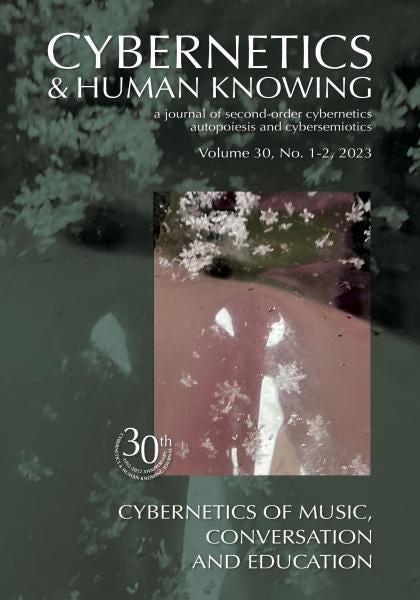
Cybernetics & Human KnowingA Journal of Second Order Cybernetics, Autopoiesis & CybersemioticsCybernetics of Music, Conversation and EducationVolume 30Issue: 1-2Year: 2023Table of ContentForeword: Cybernetics of Music, Conversation and EducationArticles: On Music, Knowing, and Black BoxesCybernetics, Education, and Psychology: Discovering Potentials (Yet) UnearthedWhat is Conversation Theory?Paskian Algebra: A Discursive Approach to Conversational Multi-agent SystemsThe Case Against NarrativeIn a Search for Deeper Meanings: Navigating the Circle of Sense and Nonsense and In Turn Articulating Logical Varieties as Knowledge IlluminatorsDesigning Sociohistorically Sensitive Information Search: Experimental Analyses of Essays Written Using ThoughtShuffler and GoogleColumn: Virtual Logic – Autopoeisis and Eigenform The Art of Self-AssemblyBook Review: The Role of Academia in a World of CrisisFeatured Artist: Ana Cristina Coura
www.antlerboy.com * curator at www.syscoi.com * The Public Service Transformation Academy - Chief Executive - www.publicservicetransformation.org * RedQuadrant - public service network consultancy - www.redquadrant.com * SCiO - non-exec director - www.systemspractice.org * Quadrant Resourcing - excellent interim change people - www.quadrantresourcing.com I tweet at www.twitter.com/antlerboy Please connect to me at www.linkedin.com/in/antlerboy benjamin.taylor@redquadrant.com +44 (0)7931317230
View all posts by antlerboy - Benjamin P Taylor























 chosen path