SE Stakeholder Engagement – Productive Conversations (0.5d)
This training programme could equally be called ‘honest conversations’, ‘difficult conversations’, ‘constructive conversations’, or ‘challenging conversations’.
Fundamental to the success and flavour of organisational life – and systems practice interventions – are the quality of conversations we are able to have. If we can develop an honest and shared attempt to get at shared understanding – shared ‘truth’ if you like – or at least to fully appreciate each others’ understanding – then we can make true progress.
This interactive session will:
Discuss different types of feedback / difficult conversation
Understand how the brain rationalises and protect us
Increase awareness of our own habits and perceptions
Prepare and plan for a difficult conversation
Have effective performance conversations
Learn how to respond / look after yourself in the moment
And help you to have productive conversations even when it seems most unlikely. You will need to bring a record of an ‘unproductive’ conversation you have had, or fear having, and be prepared to work with others around it and other examples. You will end the session with the ability to surface more productive conversations even when it is difficult.
Trainer These courses are delivered by Benjamin P Taylor, an expert in systems, cybernetics, and complexity in service transformation.
In a classic 2005 article, ‘Techniques to Match our Values’, Weisbord set out the ‘learning curve’, with a movement from ‘experts solve problems’ to ‘’everybody’ solves problems’ to ‘experts improve whole systems’ to ‘’everybody’ improves whole systems’. Inherent in the development of systems practice from the start has been recognition of ‘the whole’, which comes in various forms from group dynamics to organisational viability.
This programme will give an overview of intervention approaches which ‘bring whole systems into the room’ rather than have a few experts work on individual issues. We will look at some of the history and the wide range of interventions that have been developed, and provide an overview of some of the most interesting.
We will compare and contrast these approaches and provide ‘ways in’ to consider when, and which, large group intervention might be an appropriate part of a systems practice intervention.
Trainer These courses are delivered by Benjamin P Taylor, an expert in systems, cybernetics, and complexity in service transformation.
This module provides learners with an understanding of the design of workshops and relevant considerations, taking into account the potentially very different contexts and definitions of what a ‘workshop’ is. It introduces a range of tools and approaches for workshop design, building on the facilitation module. It gives tools to consider evaluation and learning about workshop design, and compares various approaches, enabling learners to better select and apply appropriate workshop design approaches to their context.
A workshop can be distinguished from a meeting (though the boundaries may be blurry at times), by some of the following indicators:
intensive discussion and activity, designed to progress thinking and planning
intentionally designed activities (rather than simply an agenda), or flow
an impact focus, usually above and beyond just a discussion or decision – some kind of output taking an intervention or initiative forward
An alternative use of the work, to workshop (something), refers to taking a product or idea into a period of intense focused experimentation and development, often bringing in fresh or different perspectives than the original developers of the product or idea. This is of course closely related, but implies some partly-developed ‘content’ as the workshop focus, as opposed to simply a product or idea. In either case, some input is expected to a workshop, whether process, content, or both.
The learning will cover:
What a workshop is
Where and when we might use a workshop
A range of tools and approaches
How to appropriately select an approach, and design a workshop to fit the requirements in context
The importance of reflection and how to evaluate and build a learning loop
Workshop design tools, core and conceptual
This is a very practical, hands-on course based on you creating an initial workshop design from your context, using sources offered, and sharing and discussing it in the session.
This course complements the course on Facilitation for systems practice interventions, though they can be done independently or in any order.
Trainer These courses are delivered by Benjamin P Taylor, an expert in systems, cybernetics, and complexity in service transformation.
ICS2 Facilitation Skills for Systems Practice Interventions (0.5d)
This course provides learners with an understanding of the facilitation relationship in the context of systems intervention itself, and of the challenges it brings. It introduces a range of tools and practices for facilitation and provides guidance on workshop planning. Finally, it compares various approaches to facilitation, enabling learners to develop a stronger sense of the kind of facilitator they want to be.
Topics covered include:
The facilitraining rainbow – where do you stand?
Divergence, emergence, convergence;
Differentiation and integration method;
Adaptive change;
Facilitation for ‘robust systems’;
Session planning and session flow;
The perceptual positions;
Ground rules for workshops and ways into partnership;
Maintaining your authenticity;
Peter Block’s ‘six conversations that matter’;
Chris Corrigan’s ‘seven little helpers’;
Hosting and guiding and/or customer services;
Context cues;
History and three futures;
Power tools and making concrete – Naming The Thing.
Trainer These courses are delivered by Benjamin P Taylor, an expert in systems, cybernetics, and complexity in service transformation.
ICS1b Consulting for Systems Practice Interventions – (b) Core (0.5d)
This course provides learners with a deeper understanding of:
Discovery and research into the client system;
Power questions, layers of analysis, and objectifying ‘the system’;
Research and action-based approaches;
Third-party and whole systems approaches;
Maintaining the balance of responsibility for deep engagement;
Structuring analysis and feedback, developing commitment;
Choosing dirty or clean consulting.
To maximise your chances of being effective in achieving positive change, you should combine a sound understanding of systems approaches with well-developed intervention skills.
This in turn requires a clear conception of the role of the systems practitioner as ‘consultant’, of their relationships with stakeholders, especially the ‘client’, and the nature of the practitioner’s influence on the organisations they seek to transform.
Drawing on Flawless Consulting, Barry Oshry’s Organic Systems Framework, and more, Consulting for Systems Practice Interventions emphasises a collaborative approach and equal responsibility between the intervention practitioner and the client, navigating a path between the twin traps of ‘consultant as boss’ and ‘consultant as servant’.
These courses are relevant to anyone – consultant or not! – who is engaging in organisational change.
Trainer These courses are delivered by Benjamin P Taylor, an expert in systems, cybernetics, and complexity in service transformation.
ICS1a Consulting for Systems Practice Interventions – (a) Foundation (0.5d)
This course will provide learners with key principles and a structure for interventions. Topics covered include:
The five phases of the consultative process;
‘Techniques are not enough’: relationships in consulting;
Dealing with ‘the space of service’;
Setting up a clear ‘contract’ for interventions – including triangular and rectangular contracting;
Authenticity and setting your assumptions;
The client behind the client and the problem behind the problem;
To maximise your chances of being effective in achieving positive change, you should combine a sound understanding of systems approaches with well-developed intervention skills.
This in turn requires a clear conception of the role of the systems practitioner as ‘consultant’, of their relationships with stakeholders, especially the ‘client’, and the nature of the practitioner’s influence on the organisations they seek to transform.
Drawing on Flawless Consulting, Barry Oshry’s Organic Systems Framework, and more, Consulting for Systems Practice Interventions emphasises a collaborative approach and equal responsibility between the intervention practitioner and the client, navigating a path between the twin traps of ‘consultant as boss’ and ‘consultant as servant’.
These courses are relevant to anyone – consultant or not! – who is engaging in organisational change.
Trainer These courses are delivered by Benjamin P Taylor, an expert in systems, cybernetics, and complexity in service transformation.
Are you intrigued by #horizonscanning for the future of #learninganddevelopment? If so, explore this insightful document created in collaboration with a forward-thinking client. Save it for later if you’re short on time. It offers eight thought-provoking insights challenging traditional corporate training norms:
Aligning L&D with business needs for strategic impact.
Shifting from traditional course design to a curated approach.
Empowering learners through choice and co-creation.
Embracing just-in-time learning for efficiency.
Leveraging digital-mobile methods for accessibility.
Prioritizing learning impact over quantity.
Integrating social learning for collaboration.
Personalizing learning paths for individual needs.
Join the discussion and share your organization’s practices integrating these insights. Your input matters! #Innovation #Leadership
What are the deeper reasons why our world is hurtling headlong toward social, ecological, and climate collapse? In her recently published book, The Story Is in Our Bones: How Worldviews and Climate Justice Can Remake a World in Crisis, author and activist Osprey Orielle Lake helps us discern these reasons in the dominant worldview based upon extraction and exploitation.
The book shows how the interlocking crises of colonialism, racism, patriarchy, capitalism, and ecocide have set us on this course, and opens a portal to an alternative path of restoration and justice. Building on her experience working with global leaders, systems-thinkers, climate justice activists, and Indigenous Peoples, Osprey weaves together ecological, mythical, political, and cultural insights to summon a new way of being and thinking—showing that another world is possible.
In this Deep Transformation Network live interactive conversation, Osprey will discuss with Jeremy Lent the central themes arising from her book and her work. As founder of the Women’s Earth and Climate Action Network (WECAN), Osprey has stood with Indigenous women land defenders around the world in their struggle for policies that prioritize social, racial and economic justice, and Indigenous and human rights. Jeremy will explore with Osprey how her experience of frontline activism has informed her thinking, and how the ancient story that is in our bones can lay the groundwork for an alternative Earth-centered, vibrant future.
Event Details
This online event will be hosted by the Deep Transformation Network. It is free and open to all. Following the initial conversation, DTN members will be invited to ask questions and engage directly with Osprey and Jeremy.
[In which both Wolfram and Jaimungal suddenly seem much more sympathetic to me – perhaps because they genuinely appreciate each other and each others’ company – but also because this is such fun second order cybernetics, I can even forgive the speculation on The Nature of God (which in turn has fascinating connections to the current episode of Weird Studies, on the Devil)… worth a listen, I think]
Limicon 2024 is a month-long emergent online convention for the Liminal Web and anyone liminal-curious (Game B, metamodern, integral, tpot, etc).
Part we-space, part choose your own adventure, part field-nurturing experiment, Limicon 2024 is an open-space convention from March 6th – April 3rd, where participants can co-create the events and possibilities that they want to attend.
Sign up today for $25 for a month of events at Limicon2024 dot com.
—————-
**WHY?**
We find ourselves in a liminal space between worlds, entrenched in a metacrisis, and embedded in cultural systems that are inadequate for regenerative future civilization.
We need to come together and co-navigate these uncertain times together.
—————-
**WHO?**
This event is for those in the LIminal Web or those on the edges.
We welcome practitioners, artists, ritual builders, philosophers, community weavers, scientists, activists and fans of liminal, integral, metamodern, game b, tpot, bildung, and regen communities.
We embrace anyone drawn to the question: How do we become the humans we need to be, both individually and collectively, to be in service to hospicing the old systems and midwifing the new systems that are emerging?
1. Come together – Sign up at Limicon2024 dot com 2. Surface possibilities – Add yourself to the Network Map and co-create the event schedule on the Limicon Miro https://miro.com/app/board/uXjVNEa8tqg=/ 3. Be present and Attune – Be open to connection and possibilities. Attune to what is already here. 4. Reflect and Evolve – Notice: What is happening? What are we learning? How are our connections evolving? What conversations want to emerge?
—————-
**WHEN?**
As we collectively emerge from the winter, it is time to spring up together and jolt the field into liveliness.
Limicon runs 2 weeks before and after Spring Equinox (March 6th – April 3rd).
—————-
**WHERE?**
Sign up today for $25 for a month of events at Limicon2024 dot com.
ample codeIllusions of magic and smoke rings in codeAbout← Conway’s mobProper JSON and property bags →Into the Tar PitPosted: May 19, 2020 | Author: Einar | F
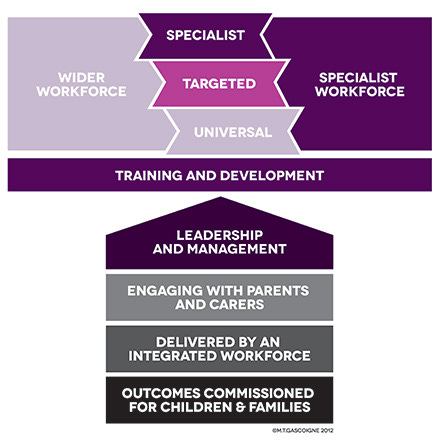
[Another discovery of another little planetary system in the universe of systems |complexity|cybernetics – this is ‘the system’ primarily of matching the right balanced of general/early/specialist interventions in speech and language therapy, though it does have a role for chidlren and families too]
WHAT IS THE BALANCED SYSTEM®?
The Balanced System® is a whole system strategic approach to supporting children and people with a whole range of needs, that has primarily come out of work in the area of speech, language and communication.
Marie Gascoigne has been developing the Balanced System® framework for over 15 years. It is used by a whole range of stakeholders, including commissioners from all disciplines and providers, particularly of therapy services.
As the diagram shows, it is a see-saw model with a set of blocks that provide the base above which balanced support is delivered.
Until I read this Hal Borland passage a few days ago I never realized/noticed that blossoming plants melt the snow, and it’s because that act generates a bunch of heat
This article is part of the series on Autonomy and Cohesion. It is the second part of the basic overview of the balance. If you haven’t read the previous part, I’d recommend doing so before reading further.
Cohesion Forces and ToolsIVO VELITCHKOVFEB 15, 202411ShareThis article is part of the series on Autonomy and Cohesion. It is the second part of the basic overview of the balance. If you haven’t read the previous part, I’d recommend doing so before reading further.
www.antlerboy.com * curator at www.syscoi.com * The Public Service Transformation Academy - Chief Executive - www.publicservicetransformation.org * RedQuadrant - public service network consultancy - www.redquadrant.com * SCiO - non-exec director - www.systemspractice.org * Quadrant Resourcing - excellent interim change people - www.quadrantresourcing.com I tweet at www.twitter.com/antlerboy Please connect to me at www.linkedin.com/in/antlerboy benjamin.taylor@redquadrant.com +44 (0)7931317230
View all posts by antlerboy - Benjamin P Taylor












 chosen path