There were further comments and questions, including Nick Kimber asking
Benjamin P. Taylor I was worried by the term nerdsniped but my 13 YO explained to me this is generally seen as a good thing. This is so generous of you to put together so big thank and agree with it all/have so much to read! I have two thoughts in response…
My day job is basically to try and support more of this way of working from a little room in 70 Whitehall. Public interest technology in the UK had a fairly coherent and tactical strategy that you point out…and it’s worked to an extent. Does relationslism need something similar? Not unrelated is a point about language and politics…NPM caught fire because it became straight forward to explain and it was politically useful to both the right and the left for different reasons. So what’s the language or frames we can develop that make it accessible to others (or indeed why does the current language not cut through?)
In response, I have set out my best summary so far of my overall approach and philosophy to this, reproduced below. (Plug: this will also be a significant focus of what we work on in the Outcomes in Complexity version of the Systems Thinking Practitioner Level 7 Apprenticeship from Cherith Simmons – last chance now to join, levy-funded if you work in England):
As Hilda Campbell says, we can overcomplicate this (and I probably do) – and the fundamental connection here is we’re all human, so we do know how to do relationships.
If you connect to yourself and to another people as humans, every transaction is a relationship. So we are innately wired to do it. (This might, of course, involve some introspection / change / change of identity / therapy over time – as we say in our work, ‘systems change’ changes you).
This is a frontline thing first – are we enabling the human beings dealing with human beings to work together as humans, some with particular expertise and authority – or are we constraining them in a rules-based system?
Notice that Michael Donnelly is ‘cheating’ – in the best way – operating ‘in place’. Well, everything is a lot simpler there!
And as you note, Nick Kimber, you are trying to influence a whole system from a little room in 70 Whitehall Place, so the answer is ‘I wouldn’t start from there’ (but, as a man in Dublin said to a friend of mine who asked if they could get to a particular place from where they were ‘to be sure, I suppose you could get anywhere from anywhere?’).
So, while relational working is not the norm in Whitehall, Whitehall is ill-placed to create the conditions across ‘the system’.
What messages are being sent to people doing relational work in government? I immediately think of: the OneTeamGov leader who – at the same time Jeremy Heywood pulled a OneTeamGov tshirt over his shirt and addressed their get-together – was told by a government press office to remove something innocuous they’d posted on the internet about the event. The civil servant who did an open question on Twitter about post-recovery priorities, and was not encouraged to post the summary of responses (which is here by the way – and worth a read https://www.dropbox.com/scl/fi/c66vmp2bkusv6i1dd6ldi/35-doughnuts.pdf?rlkey=ffozdnv00ymkn3ctylrqrcpe0&dl=0), I’m thinking of the blacklisting of external speakers who might be critical of government policy, of the (super polite) way external systems thinkers were ushered out of the Systems Thinking Interest Group conference after lunch, I’m thinking of this https://www.linkedin.com/posts/antlerboy_how-breakthrough-development-can-mean-breakdown-activity-6996017950109392896-0vlW
So just to be clear – it’s not just ‘frontline be nicer’. The centre has to be willing to be changed by the work too, otherwise it won’t be possible and would be purely extractive anyway. Leaders – including Whitehall, council chief execs, chief execs and non-execs of anchor institutions – have to submit themselves to that same work. Otherwise we’re just asking neighbourhood workers to be porous, vulnerable and adaptive while governance stays defended, positional, and adversarial. f you want relational accountability, you need relationally accountable leaders.
But – don’t please conclude that I am ‘against government’ – a rebel. You [Nick] asked this provocatively framed question:
“Public interest technology in the UK had a fairly coherent and tactical strategy that you point out…and it’s worked to an extent. Does relationalism need something similar? Not unrelated is a point about language and politics…NPM caught fire because it became straight forward to explain and it was politically useful to both the right and the left for different reasons. So what’s the language or frames we can develop that make it accessible to others (or indeed why does the current language not cut through?)”
This is why I think ‘NPM’ is a red herring and playbooks are a red herring – in fact, both are dangerous to our cause. On the first, you’ve picked up the ‘NPM’ bogeyman there and hypothesised why it was successful. I think both are not quite right (you should ask Gary L. Sturgess, who was deeply involved in New Public Management, more about it), but the point I want to make is that if we put ourselves in opposition to NPM, we fall into the ‘radical’ trap – it’s easy to be ‘radicalised’ by the way government works, but the system – to be a system – has to counteract radicals (some of what is going on in the examples above). You are not doing this, but I and so many others so often fall into oppositional behaviours which doom us to failure: https://www.linkedin.com/posts/antlerboy_provocation-relational-public-services-activity-7288194671233679361-l4yL
But you are right that clear concepts that people can get on to – and that are ‘useful’ (very correct word!) to the left and right in politics – are central.
So. What are my proposed solutions? Three things – well, four…
1- recognise that there are ‘two sides’ to this – the Centre and the Place – with *validly* different perspectives.
Treasury isn’t wrong that control is needed – one London borough introduced a famous ‘relational’(ish) approach in transactional Housing Repairs, it worked brilliantly, it just spent the entire budget in the first quarter!
Before COVID, there was a session just before the pandemic in Jerwood Space [don’t ignore the symbolism of impeccably middle-class London spaces for impeccably middle-class London people], with the National Lottery Heritage Fund and the Office for Civil Society. They brought together a load of really good people – maybe some in this thread! I was proud to be in that group. It was a nice group of people to test out their ideas – instead of both organisations funding initiatives around outcomes and places and commissioning separately, they had the idea to offer a menu of ten interventions they wanted to test, then have people bid against the menu – choose what suited their places and context.
We said ‘that’s quite good, but why don’t you do it in a co-commissioning and a shared learning way?’ i.e. let people design their own interventions based on their place, maybe with some inspiration from a menu that you offer. Then *don’t* make people bid. Engage everybody who wants to be a part of it in a learning community and let them have a say in where the money goes across the community to maximise both impact and learning. And the civil servants in the room (recent Oxbridge grads, really super bright and genuine and well-intentioned) were scribbling down like crazy. It was exciting! But I was pretty sure that they’d go back to base and it would get watered down/ignored as too complicated (but we’d never know the reasoning, the governance or how that feedback was melted away). What actually happened was, COVID struck, and it all disappeared.
So – first point – bring central and place perspectives into governance. And if you can’t do that, at least make the governance transparent.
2- get to grips with the realities of relational services in the space between actual frontline work and central control.
I’ve been working with Philip Boxer on this. We know how to do integrated and person-centred, relational services, at the service level – and they get better results at lower costs. But the good examples – and there are many – largely depend on special circumstances. The successes are local and usually short-lived. And attempts to scale fail.
Apart from the actual services around the person, there are three challenges:
a) Co-ordinating the capability. Relational services are the most difficult to manage:
– they demand real-time coordination of an ecosystem of activities outside the organisation.
– so you only engage with them as an organisation *if you really have to* and *when you really have to*
b) The governance ceiling of the system
Our governance capability is not able to deal with relational services – they require accountability horizontally – to results in the real world – not vertically – to hierarchical governance (where we have a carefully-baked-in Accountability Avoidance system which is – for obvious reasons – highly prized by managers)
c) Dealing with organisational defences
They challenge our identity as an organisation and as managers, so we have to tread very carefully in the psychology of the change (and most of our techniques directly trigger managerial and organisational system defences).
And therefore we build bubbles which depend on heroic ‘rebel leaders’ (who have accepted a devil’s bargain of taking on all the risk and accountability to shield the organisation) and which disappear when they go.
The organisation constantly asks ‘ok, this is great – how do I either target this, or take it to scale’, and we have no response, because we’ve conceptualised relational public services as outside and a reaction to ‘the system’, and accepted the costs of that without seeing them.
The answers here are pragmatic and have to be presented pragmatically to managers, budget-holders, politicians:
* real-time live data which can track costs and outcomes and demonstrate benefits is becoming possible – this can bring relational services in
* to make this work you *need* transactional services, you need professional capability and structure and systems which can be called in and marshalled around customer need
* fundamentally you have to have a positive story… ‘we can take those complex areas away without threatening the transactional issues…’
* and have to address the strategy ceiling and governing mentality – and the only way to change what can be understood is by finding the situations where you need more relational services, make the argument, prove it and do…
We’ve done the pilot (proof of concept). Each place needs a pathfinder (how to do it here)/. But the real challenge is scaling: dealing with the immune system response.
3- reconceptualise the divide between ‘service’ and ‘citizen’
What I’ve been talking about as ‘place’ (as opposed to ‘centre’) is really still public service institutions – what community development refer to as institutional as opposed to associational life.
To bring it back to the simplicity of ‘help people to embrace their humanity’ – and your ‘easy to understand messages’ – I like three ‘models’, two from Cormac Russell
The first is reconceptualising the ‘four worlds of service’, moving from seeing the four ways of working (‘done to’, ‘done for’, ‘done with’ and ‘done’ by’) as separate possibilities, to seeing them as embedded in each other
– work done ‘to’ people should be by free, prior, and informed consent, a small sub-section of
– work done ‘for’ people but decided by them, a small subsection of
– work done ‘by’ people but with help, a subsection of
– work done by the people in their communities
(We don’t have local government, or policing, or anything, without the consent of the community).
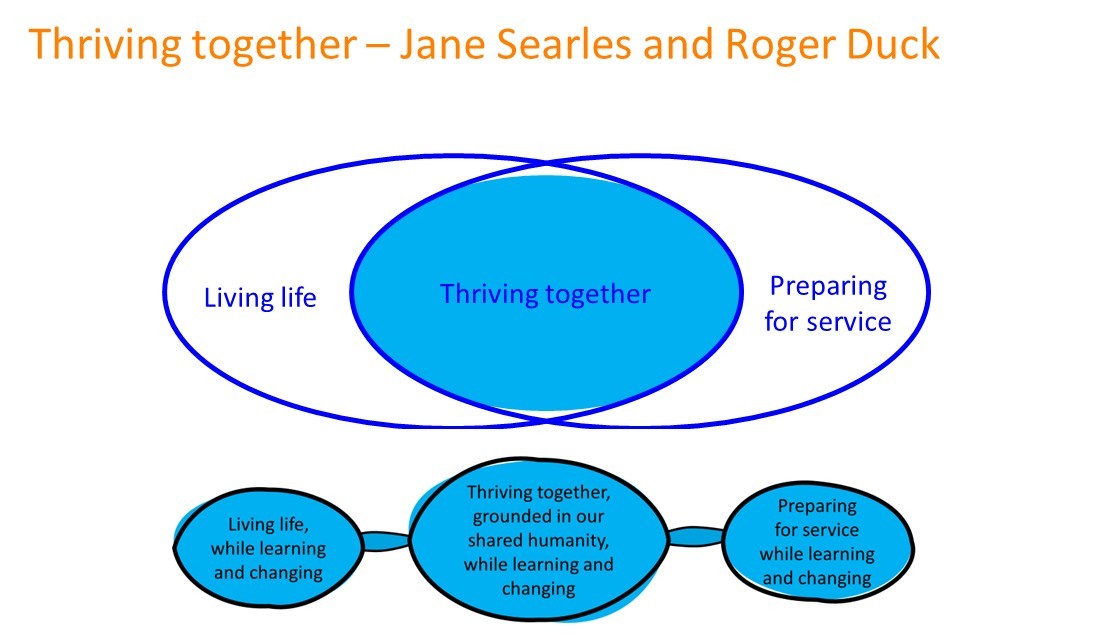
Thirdly, Jane Searles and Roger Duck have the ‘thriving together’ model. This says there are three ‘worlds’ that come together.
In the first world we live our life. In the second world, we prepare for service, building strengths and capabilities in various ways. In the third world, people living their life work with people well-prepared for service to thrive together. In all three worlds, we are all citizens.
I remember it this way: the fire service knows well that fire services fight no fires. It’s people that fight fires, people prepared for that service with the training, protocols, kit, equipment, capabilities, and other resources the fire service providers. We call these fire-fighters – we could also call them nurses, social workers etc. The statutory duty of the fire service is to ‘prepare to respond’; they are prepared citizens.
[Interestingly, the fire service has fully committed to the erroneous ‘it would be deadly for any non-fire service citizen to attempt to fight any fire’ and therefore ‘get out, call us out’ actually costs us lives and property versus building wider fire-fighting capabilities in the wider community].
So we need coherent ways to be situated in ‘citizen space’ all the time.
4) Finally, let’s not underestimate the realities of power and ego in all of this.
Your post, Nick Kimber, is so popular because you are perceived (however you may feel about it!) as having a lot of power. Therefore speaking to you creates opportunity. Part of what kept me up on a Friday night and back at my desk on Sunday is the opportunity to have you hear me – passion, yes (let’s assume we all deeply care about this), but also ego, also perhaps we can finally do more substantial amounts of work in this space, make the difference we want, but how much energy and success that would create for my business! I’ve seen so much denial of this in this space – while fervently practicing it – and it doesn’t help.
So far the approach has been, as Philip Boxer says, ‘Let’s all agree this is how the world should be and if we can agree that, we can persuade others and get the world to follow us’. But we have to bar in mind how people are currently invested in organisation. ‘We can all sing Kumbaya – but it won’t help if we are naïve in dealing with structural issues, naïve in dealing with power’
So how to make the shift?
1 set the example with open and coproduced governance
(or, if you can’t, get out of the way and make the funds and ownership and learning distributed – this might be the only way to cut the Gordian knot, but leaves us with the risk of continued polarisation of thinking)
2 recognise the realities of taking relational services to scale
3 reconceptualise the ‘provider / Poor Sick Miserable Person’ paradigm as ‘people thriving together’
4 make all our interests in this discussable
And make the steps to adoption pragmatic – not a rebellion, not a paradigm shift, just solutions to organisational and political problems.
Simples! As one gooroo likes to say…
But where can you actually start on Monday morning? Michael Donnelly names a very live anxiety: ‘I feel sorry for anyone leading in complex settings — how can they know where to start at all?’ And he also has a great solution – bring people in place into a transparent shared space where they can see each other, learn in real time, and own the work together. Start by getting the whole system in the room, in the place, looking at the real work together, and keep that going as infrastructure – not as a workshop. That’s how we do this in Doncaster, and potentially doable in Whitehall language (‘we’re funding locally-owned whole-system learning platforms’).
(But don’t ask for reports back, the centre can’t learn – while you’re in the Cabinet Office, see if you can find all those Knowledge-Sharing Deliverables we all produced :-D)
www.antlerboy.com * curator at www.syscoi.com * The Public Service Transformation Academy - Chief Executive - www.publicservicetransformation.org * RedQuadrant - public service network consultancy - www.redquadrant.com * SCiO - non-exec director - www.systemspractice.org * Quadrant Resourcing - excellent interim change people - www.quadrantresourcing.com I tweet at www.twitter.com/antlerboy Please connect to me at www.linkedin.com/in/antlerboy benjamin.taylor@redquadrant.com +44 (0)7931317230
View all posts by antlerboy - Benjamin P Taylor
Published
6 thoughts on “How to move to relational public services”


 chosen path
See also
Cheat sheet for more relational customer-first services
https://chosen-path.org/2026/02/03/4959/
LikeLike
See also
https://chosen-path.org/2025/12/16/relational-public-services-and-reality/
https://chosen-path.org/2025/10/28/how-do-we-change-the-way-we-relate/
https://chosen-path.org/2025/01/23/are-the-rebels-with-a-cause-actually-preventing-the-very-change-they-campaign-for/
LikeLike
An appropriately collaborative story of the unfinished history of relational public services is now here
https://chosen-path.org/2025/12/02/a-hundred-origin-stories-an-unfinished-history-of-relational-public-services-parker-dove-and-taylor-2025/
LikeLike