
I fed ChatGPT the transcript of two calls I made complaining about one of the many hassles I’ve had to deal with in the last few months. I dislike myself when I get angry and I’m frustrated that whatever I try seems ineffective, so I asked it to advise me how to be more effective under stress in these situations. I think it’s quite interesting, some highlights below (specific details of the situation removed). I’ll certainly be trying it out – but what it highlights to me is that, really, I have to reconcile myself to the fact that these businesses have built impenetrable obstacles to getting satisfaction…

What is happening structurally
You are entering a tightly scripted, low discretion system while behaving as a high agency actor. The mismatch is the core problem.
Call centre staff operate under:
- rigid scripts and authority boundaries
- zero legal discretion
- risk avoidance incentives
- performance metrics tied to call duration and complaint closure
You operate under:
- urgency
- moral certainty
- legal framing
- high cognitive load
- genuine risk exposure
The system cannot meet you where you are. So it defends itself.
Once you understand that, the rest becomes easier.

What you do well
Several things you do are strong and worth keeping.
- You state the facts repeatedly and consistently.
There is no drift or contradiction in your narrative. - You explicitly regulate your emotions out loud.
Saying ‘I am trying to stay calm’ is actually helpful. It signals self-awareness and reduces the chance of call termination. - You document liability clearly.
Putting liability ‘on record’ is rational and later useful in writing. - You resist premature closure.
You do not accept ‘two months free’ as resolution. That is correct if your aim is leverage rather than appeasement. - You persist across handoffs.
Many people would have dropped out earlier.
These are not the problems.
What is reducing your effectiveness
There are four recurring patterns that materially weaken your position.
- You argue law with people who cannot process law
This is the single biggest issue. It triggers defensive shutdown
Why? Because the agent cannot acknowledge this without personal or organisational risk. So they must negate, reframe, or stall.
Result: You burn time and emotional energy without increasing leverage.
Key insight: Legal correctness is irrelevant at the call centre layer.
- You over explain context that the system cannot act on
All true. All human. Almost all useless at this layer.
The system can only compensate for a very narrow range of things.
Everything else is noise from its perspective.
Result: Your strongest points are diluted by volume.
- You oscillate between collaboration and legal threat
This confuses the interaction frame.
The agent does not know whether this is:
- a negotiation
- a complaint
- a legal pre-action notice
So they default to the safest option: minimal commitment.
- You stay in the wrong channel too long
Once the errors are acknowledged, the phone is the wrong medium.
You continue to invest effort in synchronous conversation when:
- escalation power has plateaued
- decision authority is exhausted
- written records now matter more
This increases your stress without increasing outcomes.
How to be more effective next time
Adopt a two mode strategy: call mode and paper mode.
Call mode: strict, narrow, instrumental
Your only objectives on the call are:
- confirm facts on record
- extract explicit admissions
- secure reference numbers
- identify the correct written escalation route
Nothing else.
What to do differently on the call
- State the issue once, in 30 seconds
Script it. Literally.
Then stop.
- Do not argue liability verbally
Replace all legal language with one sentence:
‘Please note I am reserving all my rights.’
Then drop it.
- Treat goodwill offers as data, not negotiation
Say:
‘Thank you. Please record that as an interim goodwill gesture, not a resolution.’
Repeat as needed.
- Exit early
Once you have:
- complaint reference
- confirmation of error
- named team or email
end the call.
Paper mode: your real leverage is written, not spoken.
Within 24 hours, send a concise written complaint containing:
- timeline
- verbatim sales claim
- consequence directly attributable to service loss
- remedy sought
No emotion. No hypotheticals. No threats.
Then, and only then, if needed:
- escalate to deadlock letter
- escalate to ADR or ombudsman
- involve legal counsel
Why this works
Because written systems:
- tolerate legal framing
- trigger internal reviews
- create audit trails
- shift the risk calculus
Phone systems do not.
A final reframing
You are not ‘bad under stress’. You are operating at the wrong level of the system.
You are trying to do third order problem solving inside a first order script.
The solution is not more control or more force.
It is earlier abstraction and earlier exit.
Realising I had made the mistake of telling it I was the customer (and its general obsequiousness), I asked it for advice for agents on ‘handling difficult customers’ and ‘how to advise difficult customers like this to behave in these stressful situations’
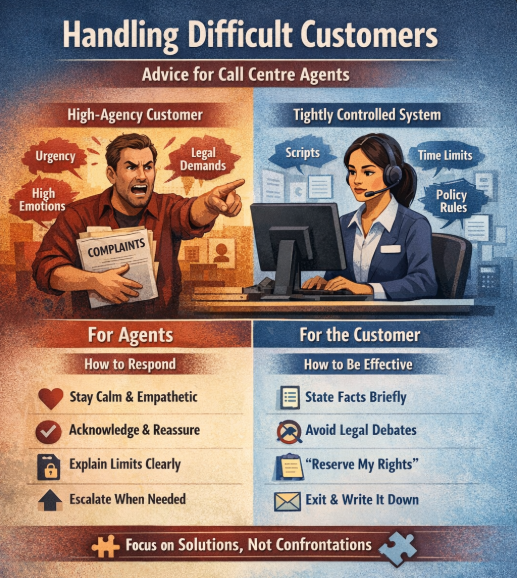
One-page difficult customer playbook for advisers
Purpose: turn high emotion into forward motion. Restore control, ownership, and a credible plan.
The first 60 seconds
- Name the impact
‘I can hear this has XXXX. That’s serious.’ - Take ownership
‘I’m going to own this with you now. I will not pass you around unless we agree why.’ - Set the agenda in three steps
‘First I’ll confirm what happened. Second, the fastest way to restore any working service. Third, complaint and goodwill.’
Do and don’t language
Do say
‘Here’s what I can do right now.’
‘You won’t need to repeat yourself. I’ve got it noted.’
‘Two tracks: service restoration first, then complaint and goodwill.’
‘I can’t do X from this system, but I can do Y and Z.’
Don’t say
‘There’s nothing we can do.’
‘That’s the way the system works.’
‘We’re not liable.’
‘Unfortunately…’ (swap for a concrete action)
The core moves that de-escalate
- Build a shared model fast
‘Here’s what I think happened: XXXX. Is that consistent with what you’re seeing?’
If you are not sure, say you are not sure and name what you are checking. - Offer options, even if they are constrained
Give 2 to 3 options with timelines.
Customers calm down when they can choose. - Hold the boundary on legal arguments without sounding evasive
‘I hear you. I can’t make legal determinations on this call, but I will record your position in the complaint and make sure it is reviewed. Right now, let’s get service back.’ - Handle holds like a contract
Before hold: reason + time + promise to return.
‘I’m checking provisioning notes and delivery tracking. About 2 minutes. If I’m not back in 2 minutes, I’ll return with an update.’
After hold: thank + what you found + next step. - Prevent repetition and transfer trauma
If you must transfer, do a warm handover and summarise:
‘I’m transferring you to X because they can authorise Y. I’m briefing them now: (reiterate core details). You won’t need to repeat it.’ - Protect customers from cost and fatigue
e.g. if they are abroad, offer to email details. - Don’t downgrade earlier offers
If any colleague offered goodwill, treat it as a live commitment until you have confirmed otherwise.
‘I can see that offer was discussed. I need to validate it with my manager, and I’ll come back with a clear yes or no.’
Micro-scripts for difficult moments
When they shout
‘I want to help. I can do that best if we keep it to one voice at a time. I’ll listen, then I’ll give you options.’
When they demand a manager
‘I can escalate, and I also don’t want you waiting longer. Let me do two minutes to pull the facts and options, then I’ll bring a manager in with a clear summary.’
When they repeat ‘you’ve ruined my life’
‘I hear how big the impact is. Let’s get practical: fastest route to working internet at the property is…’
When you need to say no
‘I can’t do that action from here. What I can do is A now, B within 24 hours, and C as an escalation today.’
Minimum call outputs for high-stakes customer impact
Before you end the call, the customer should have:
- A clear explanation of what happened in plain language.
- A chosen option with a timeline.
- Named ownership: who is doing what next.
- A written summary (SMS or email) if possible.
- Complaint reference and what will be reviewed.

Short coaching note for customers: how to complain effectively without self-sabotage
Aim: get restoration done quickly, then get redress. Do not let anger slow the fix.
Use a clear simple opening script. Keep it structured: headline then three facts
- What happened (one sentence).
- Why it matters (one sentence, concrete risk).
- What you need (one sentence, time-bound).
Ask for ‘owner, options, timeframe’
‘Who owns this now?’
‘What are the options you can do today?’
‘What is the timeframe for each?’
If you ask only one thing in the whole call, ask this.
Run two tracks, in this order
Track one: restoration.
Track two: complaint and compensation.
Say it explicitly:
‘Let’s get things fixed first, then we’ll do the complaint and goodwill.’
Avoid these traps (they feel justified but slow the fix)
- Threatening legal action early
It often pushes the handler into policy mode and delays practical steps.
If you need to preserve your position, say:
‘Please note I’m reserving my position. For now I’m focused on restoring service.’ - Repeating the whole story
Instead, say:
‘I’ve explained the background. Can I summarise in 20 seconds and then we move to options?’ - Bundling ten asks
Do one at a time:
a) confirm what happened
b) fastest restoration route
c) confirm delivery and activation steps
d) complaint reference and goodwill
Regulate your tone without pretending you are fine
Use this sentence when you feel yourself escalating: ‘I’m stressed and I don’t want to take it out on you. I need a practical plan in the next two minutes.’
If they put you on hold
Set a boundary: ‘Please tell me what you’re checking and how long it will take. If it’s more than two minutes, can you email me the outcome?’
If you need to escalate
Ask for escalation with purpose, not status: ‘Please escalate to someone who can authorise X or speed up Y. I want the right person, not just a manager title.’
Get it in writing
Before ending, ask: ‘Please email or text me: what happened, the plan, the timeline, and the complaint reference.’

 chosen path