
What do we mean when we say ‘relational’ in public services? Join the conversation on LinkedIn: https://www.linkedin.com/posts/antlerboy_what-do-we-mean-when-we-say-relational-activity-7439590693385392128-Advx/
What do we mean when we say ‘relational’ in public services?
Not ‘be nicer’. Not ‘have a chat before the assessment’. Not ‘relational good, transactional bad’.
Relational is about how the world is ordered.
– A transactional world says: make your request, I’ll process it how I choose, we’re done when I say we’re done. All the power is with the provider.
– A relational world says: who are you, what’s going on, and how do we move forward – together. It recognises that all value is co-created.
The difference sounds soft, but it’s really important. And this isn’t about coercion versus consent – it’s about how the interaction is understood.
Transaction and relation are not opposites. They are unstable companions, actually different types of relating. Push either far enough and it becomes the other.
– A scripted call can become real care when someone notices something that doesn’t fit.
– A long-term caring relationship can collapse into task, tally, and compliance under pressure.
– A ‘difficult’ citizen who keeps calling isn’t just ‘demand’. Often they are in a real, and important, relationship with the service – albeit based on dependence, testing, recognition, sometimes even antagonism.
Sometimes the surest proof that a relationship exists is the hole it leaves when it stops.
So the question isn’t ‘should we be relational?’ It’s:
– what is the power dynamic here?
– what is this interaction becoming?
That makes it practical.
Start with demand. What are people actually bringing, not what the system hopes they’ll say. Understand that behind demand is need, behind need are purposes in people’s lives.
Be clear what must be transactional and what must be relational. A passport renewal is mostly the former. Safeguarding isn’t.
Protect judgement at the boundary. If nobody is allowed to notice and respond, you don’t have relationality – you have theatre.
Design transactions to serve relationships, not crowd them out. Forms, scripts, triage, targets – these should create space for human response, not eliminate it.
And use a simple test: after contact, is the person more capable, or less?
This is where most public services go wrong. We build a transactional world, then try to sprinkle relational moments on top. It doesn’t work. The system absorbs them.
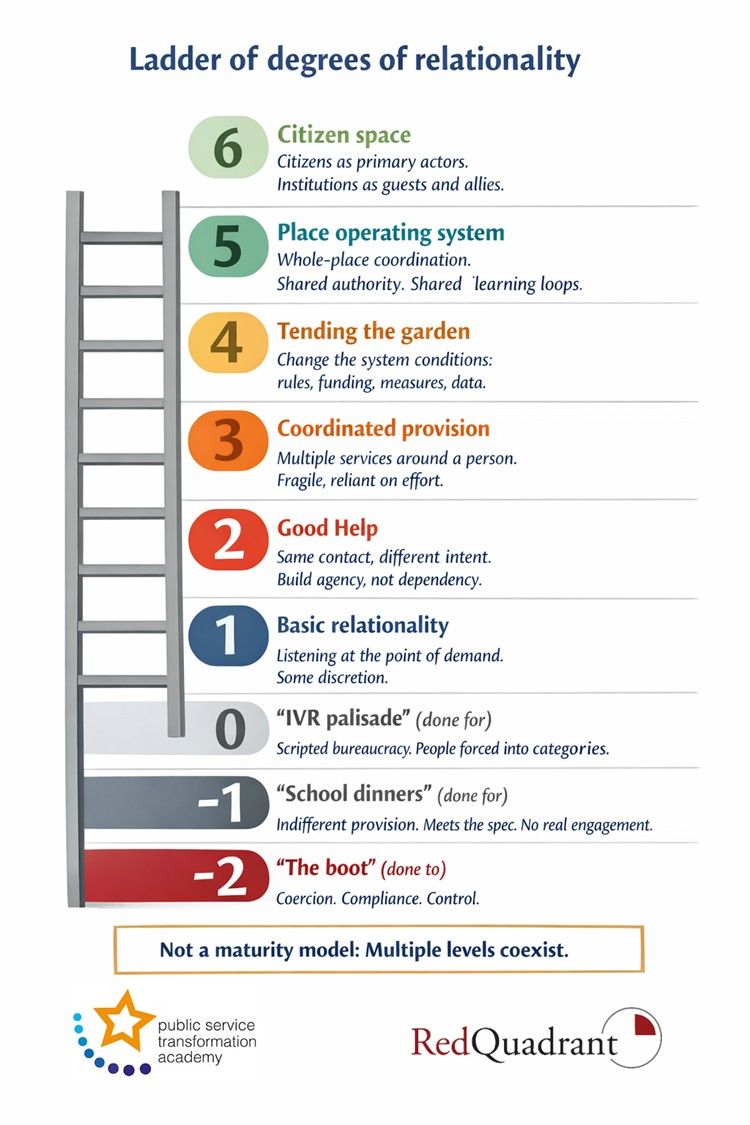
If you want relational public services, you have to flip it: ‘a relational world, seasoned with transactions’. (Thanks to Roger Duck and everyone else whose work is in this post!) That means shifting where authority sits, how learning works, and what we measure.
So when we say ‘relational’, we’re not describing a tone.
We’re describing a different operating system for public services – one where people are not just processed, but recognised, and where transactions strengthen the relationship rather than hollow it out.
Most public services think they are delivering transactions with occasional relationships. In reality, they are already in relationships – they’re just a bad partner.
Does this resonate?
 chosen path
One thought on “What do we mean when we say ‘relational’ in public services?”