

What ethical or spiritual belief system is tucked away, perhaps in your back pocket, influencing you even if you don’t acknowledge it? https://www.linkedin.com/posts/antlerboy_what-ethical-or-spiritual-belief-system-is-share-7456816557772500992-7jfj
What ethical or spiritual belief system is tucked away, perhaps in your back pocket, influencing you even if you don’t acknowledge it?
I’ve been thinking about it since my dad’s wake, my uncle’s eulogy on the line ‘Glory to God, who bids us fight for heaven here in the dust and joy of human life!’ (Lord of good life – United Reformed Church hymn 533), and a conversation with his best friend, who also died this week: RIP Oliver Westall.
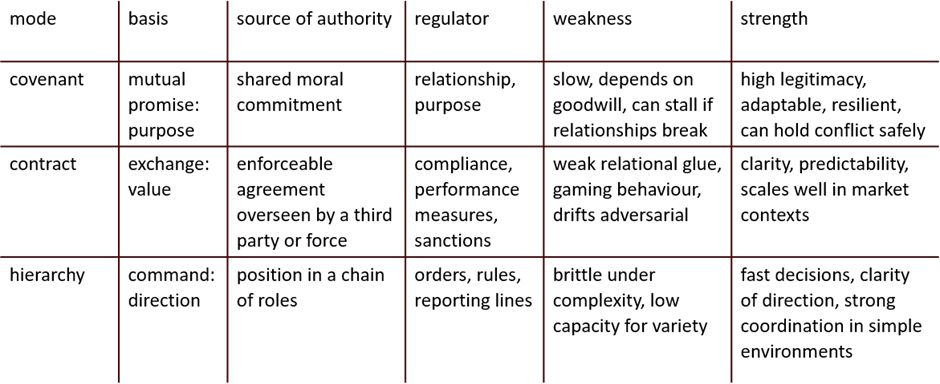
I think this is part of mine: organising under a covenant.
A covenant system is a way of organising people, power, and purpose held together by mutual promises about purpose, identity and behaviour, rather than by contract or command. It is older than modern management theory.
People say, in effect: ‘we promise to be this kind of community, for this kind of work, and to hold one another to it.’
It’s therefore based on shared moral commitment, not transaction or rank, and regulated by relationships and agreed purpose, not rules alone.
Authority – which flows from commitment not enforcement – is naturally distributed and consent-based; leaders serve the covenant, they don’t own it. Issues are brought back to the gathered body (meeting, assembly, forum) for discernment and correction, difference is tolerated – because unity comes from commitment, not uniformity.
So the covenant sets a cybernetic reference point, creates internal feedback loops, and allows distributed error-correction (anyone can call the community back to its promises).
There’s high tolerance of dissent and diversity, including theoretical, spiritual, and experiential – charismatic energy (for example) is neither obeyed nor excluded, it is evaluated for how it might serve the shared promise and purpose, and therefore tends to be moderated and to moderate traditionalist extremes too, through discernment, accountability, and engagement.
If not backed by good practice and structure, there are clear (and familiar) failure modes: a collapse into niceness, where the ‘covenant’ becomes sentiment, and no-one challenges harmful behaviour or poor performance; a shadow hierarchy; and decision entropy where decisions are tied up in consultations seeking consensus and only drift or crisis shifts the system.
It works best when work is complex, values-laden, and relational, and you need commitment without strong coercion, autonomy with coordination, and resilience in the face of disagreement, and perhaps conflict containment without avoidance.
Covenant, contract, and hierarchy of course all tend to interact in most forms of organisation – and covenant often actively and intentionally holds a tension with hierarchy (or synody) and with norms/ethos.
What’s your inheritance or gift of this type?
(The concept of a (specifically) ‘puritan’ inheritance ‘tucked in the back pocket of a pair of Levi’s in a less austere age’ appears – in different forms – in both The Puritan Gift by Kenneth and William Hopper, and The Tinkerings of Robert Noye by Tom Wolfe)


One thought on “What ethical or spiritual belief system is tucked away, perhaps in your back pocket, influencing you even if you don’t acknowledge it?”