
Thesis: you can tell the decade a WEIRD management model came from by what it fears — and the remedy it prescribes. Join the conversation on LinkedIn. https://www.linkedin.com/posts/antlerboy_thesis-you-can-tell-the-decade-a-weird-management-activity-7459610782557777924-DtK4?utm_source=share&utm_medium=member_desktop&rcm=ACoAAACuq-oBecVFDW6PCf3lkoG-peMeuLBeoho
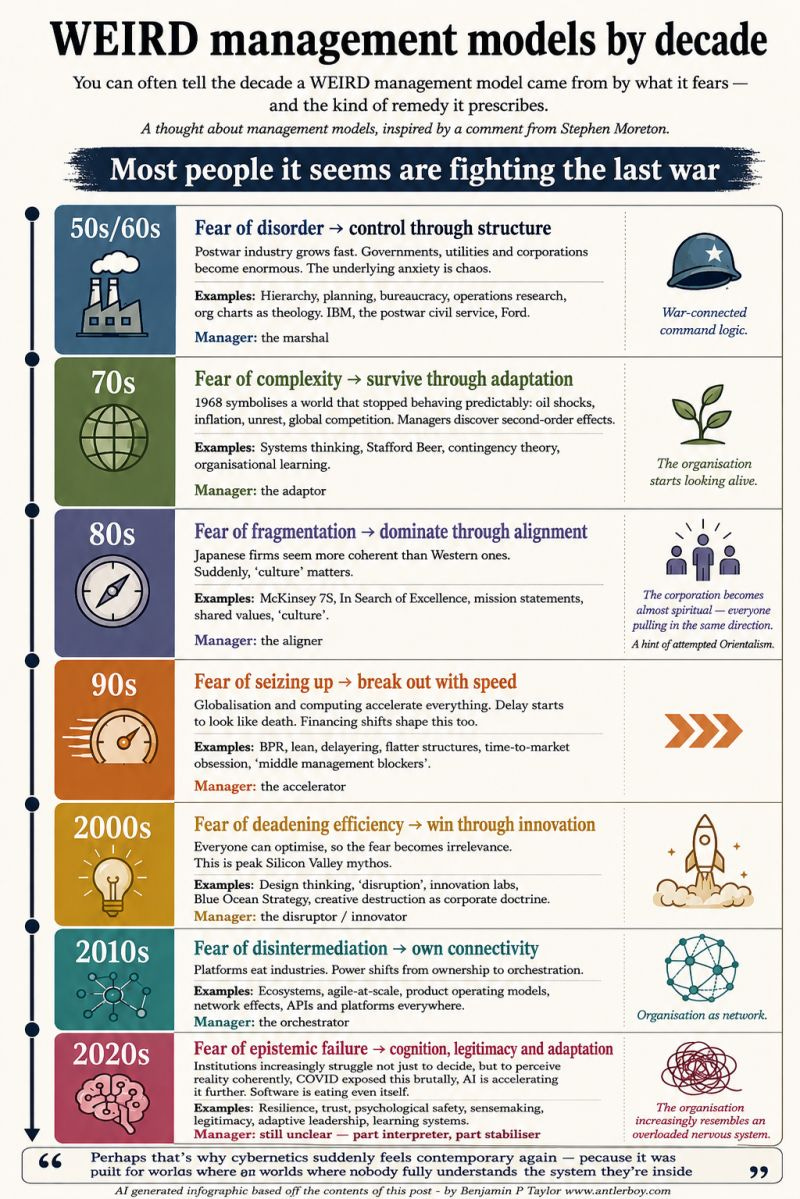
Thesis: you can tell the decade a WEIRD management model came from by what it fears — and the remedy it prescribes. (A thought about management models, inspired by a comment from Stephen Moreton.)
I think it looks something like this (and I think we can do better):
50s/60s
Fear of disorder: control through structure
Postwar industry booms. Governments, utilities and corporations become enormous. The underlying anxiety is chaos.
So: hierarchy, planning, bureaucracy, operations research, org charts as theology. IBM, postwar civil service, Ford.
The manager is the marshal; something very war-connected here.
70s
Fear of complexity: survive through adaptation
1968 symbolises a world that stopped behaving predictably. Oil shocks, inflation, unrest, global competition.
Managers discover second order effects. We get systems thinking, Stafford Beer, contingency theory, organisational learning.
The organisation stops looking like a machine and starts looking alive.
Manager as steersman?
80s
Fear of fragmentation: dominate through alignment
Japanese firms more coherent than Western ones. ‘Culture’ matters?
McKinsey 7S, In Search of Excellence, mission statements, ‘shared values’, ‘culture’ — the corporation becomes almost spiritual: everyone pulling in the same direction. A bit of attempted Orientalism?
The manager ‘aligns’.
90
Fear of freezing up: break out with speed
Globalisation and computing accelerate everything. Delay becomes death.
We get BPR, lean, delayering, flatter structures, time-to-market., ‘middle management blockers’.
(Financing shifts align and shape all of this too of course)
The manager becomes the accelerator.
2000s
Fear of deadening efficiency: win through innovation
Everyone can optimise, so the fear is of irrelevance.
Design thinking, ‘disruption’, ‘innovation labs’, ‘blue ocean strategy’: creative destruction as corporate doctrine, peak Silicon Valley I mythos.
Manager as disruptor/innovator.
2010s
Fear of disintermediation: own connectivity
Platforms eat industries. Power shifts from ownership to orchestration.
Ecosystems, agile-at-scale, product operating models, network effects. APIs and platforms everywhere. Organisation as network, manager as orchestrator.
2020s
Fear of epistemic failure: what’s needed is cognition, legitimacy and adaptation… institutions increasingly struggle not just to decide, but to perceive reality coherently.
COVID exposed this brutally, AI’s accelerating it further, software’s eating even itself.
So management language fills with resilience, trust, psychological safety
sensemaking, legitimacy, adaptive leadership, learning systems. Organisations overloaded nervous systems.
Perhaps that’s why cybernetics feels contemporary again — because it was built for worlds where nobody fully understands the system they’re inside.
Most people it seems are fighting the last war…
See below if you want to try out a little diagnostic — three minutes.
Anyway, what do you reckon?