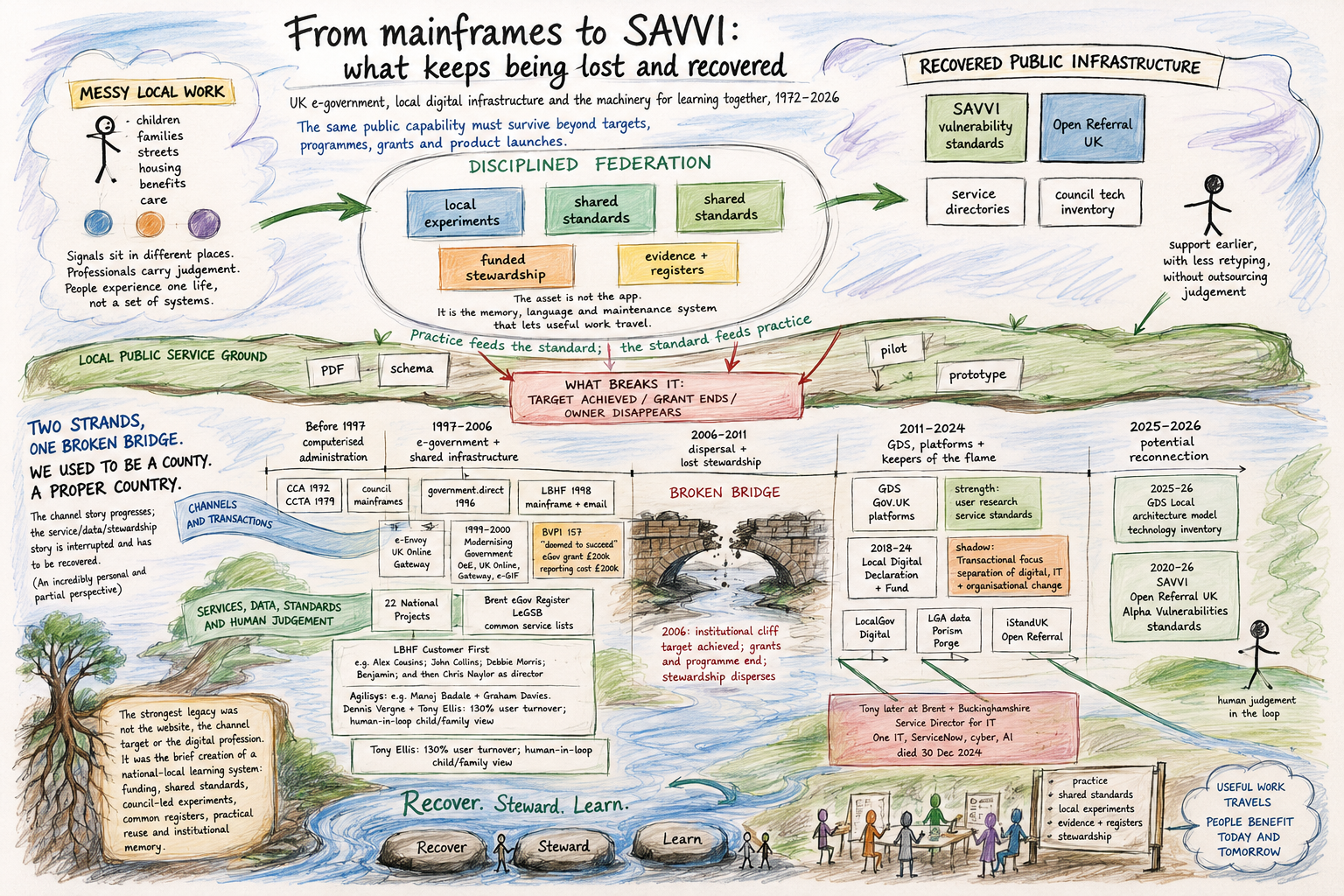

From mainframes and BVPI 157 to SAVVI, Open Referral UK and the unfinished business of local digital government
Join the debate on LinkedIn https://www.linkedin.com/posts/antlerboy_localgovernment-datastandards-publicservicetransformation-share-7488562400292671488-9s2A/
‘We can’t, we don’t know how to do it any more’
When I joined Hammersmith & Fulham in 1998, the council ran on a mainframe. We introduced internet email that year (and I borked it: different story)…

[This is a very personal/partial story, done in a bit of a rush – the LinkedIn post content is here and, below the fold, the fuller piece]
2003-04 I was eGovernment Manager, dealing with BVPI 157: make every suitable service ‘available electronically’ by the end of 2005.
A classic: doomed to succeed, demanding gaming.
A transaction could be ‘e-enabled’ (even by phone or fax!) while the service, hand-offs and failure demand behind it remained untouched.
I calculated for ODPM that collecting and reporting the data cost £200,000; the same as our eGov grant.
A small, perfect tragedy of target-based reform: spending money to make a narrow definition of success legible.
BUT the best of that period wasn’t the target. It was the learning machinery it: 22 council-led National Projects, common standards, the Brent eGovernment Register, funding for experiments and an expectation that useful work would spread.
At H&F, Alex Cousins assembled a cross-council Customer First team – me, John Collins from Council Tax, Debbie Morris from Enviroment. Agilisys’s Manoj Badale and Graham Davies worked with us on the strategy as part of the ‘strategic partnership’.
Dennis Vergne, Chris Naylor and many others turned that strategy into Residents Direct, Smarter Borough, and Community Support: different operating models for different work, rather than one contact centre treating every need as a transaction.
I want to mention Tony Ellis in this history too. Faced with 130% user turnover on the Children’s Services IT system, he didn’t reach first for more training or tighter compliance. He developed a quality-improving, human-in-the-loop view of children and families: data supporting professional attention and judgement, not replacing it.
Tony later helped Buckinghamshire establish the unitary council’s systems, pandemic working, cyber-security and practical AI. He died unexpectedly in December 2024, far too early.
Then, much of the wider e-government system was dispersed.
GDS later did exceptional work. It also helped make ‘digital’ a separate profession, often focused on selectable transactions and detached from IT, operations, data and organisational change.
The embers survived through the likes of the LGA’s data work, LeGSB, iStandUK, Open Data UK, Porism, Porge, LocalGov Digital.
Now some threads may be reconnecting.
The Data Standards Authority has published Alpha Vulnerabilities Data Standards developed through SAVVI and iStandUK. iStandUK is also convening councils around national data sources for local service directories.
Unglamorous plumbing – but serious work on making information make a difference in people’s lives.
Which shared public infrastructure have we already invented, forgotten – and now need to recover?
Two practical ways to contribute:
Councils can join iStandUK’s online workshop on 18 August to identify national Government, health, public-service and charity data that could feed local service directories:
https://www.eventbrite.co.uk/e/national-data-for-local-services-workshop-tickets-1994682716701
The Data Standards Authority is also seeking feedback by 21 August on whether the Alpha Vulnerabilities Data Standards are practical and usable in real settings:
https://dataingovernment.blog.gov.uk/2026/07/14/improving-support-for-people-at-risk-through-better-data-introducing-the-vulnerabilities-data-standards-alpha/
I’m very proud our consutlant Andrew Humphreys has been working with SAVVI for some time, and continues to do so!
We did not lose the technology. We lost the machinery for learning together
From mainframes and BVPI 157 to SAVVI, Open Referral UK and the unfinished business of local digital government
When I joined Hammersmith & Fulham in 1998, the council ran on a mainframe. We introduced internet email that year, and I managed to bork it, although that is another story. By 2003–04 I was the council’s eGovernment Manager, dealing with BVPI 157: the requirement that every suitable council service should be ‘available electronically’ by the end of 2005.
We were doomed to succeed.
The definition made success constructible. A transaction could be counted as ‘e-enabled’ even if the underlying service, the hand-offs between teams and the avoidable demand generated by the system remained untouched. A person could send an electronic request for an appointment, referral, call-back or transfer and the interaction could count as a success, even though the real work had not begun and the person’s need had not been met. Telephone and fax could count as electronic channels. The target encouraged councils to make interactions legible to the performance system without necessarily making services more effective for the people using them.
I made the case in a submission to the Office of the Deputy Prime Minister that collecting and reporting Hammersmith & Fulham’s BVPI 157 data cost about £200,000. That was roughly the value of our e-government grant. There is a small, almost perfect tragedy of target-based reform in spending the money intended to improve services on making a narrow definition of success visible to the centre.
Yet that is not the whole story of local e-government, and it is not even the most important part. The best of that period was not the target. It was the machinery that grew around it: the 22 council-led National Projects, shared standards, common service descriptions, the Brent eGovernment Register, funding for local experiments and an expectation that useful work developed in one place should spread to others. For a brief period, central government and local government created something close to a national learning system.
That system was incomplete and often frustrating. It was not a golden age, and many of the claims made for e-government were exaggerated. But it created a capability that later programmes have repeatedly had to rediscover: the ability to combine central support, local experimentation, shared standards, common infrastructure and institutional memory.
The current relevance is direct. SAVVI, Open Referral UK, iStandUK, the Local Government Association’s data work, GDS Local, the Local Government Architecture Model and the effort to build a shared picture of council technology estates are not peripheral technical initiatives. They are attempts to reconstruct the public capability that allows local places to improve without every council separately buying, inventing, cleaning and retyping the same things.
The history matters because it shows that we did not primarily lose the technology. We lost much of the machinery for learning together.
Three histories that are too often confused
The history of UK e-government is often told as a sequence of technologies: mainframes, personal computers, websites, portals, smartphones, cloud services, platforms and artificial intelligence. That is not entirely wrong, but it is not a useful account of what changed, what failed or what now needs to be recovered.
There are at least three overlapping histories.
The first is the history of government computerising its own administration. The second is the history of making government services accessible through new public channels. The third is the history of trying to redesign public services around people, places, information and professional judgement.
These are related but different. A new administrative system can process work more efficiently without improving a person’s experience of the service. A website can make it easier to submit a request without reducing the number of hand-offs, delays and errors behind the interface. A skilled digital team can redesign a transaction while leaving the policy, organisation, supplier arrangements, casework and data structures around it largely unchanged.
The strongest moments in the history held all three questions together. They used technology to improve administration, access and the underlying design of services. The weaker moments allowed one part to stand in for the whole. ‘Digital’ became a new channel, a profession or a set of design methods without necessarily changing the wider system that produced the service.
This distinction is particularly important in local government because much of its work is not reducible to a single transaction. Some things are properly transactional. A person wants to pay, report, apply, book or check something. Other work is relational, contested and dependent on judgement. A child may be at risk. A family may be struggling across housing, health, education and income. A place may be experiencing a pattern of problems that no single service owns. In this work, the information system should support attention and judgement rather than defining the limits of what the professional is allowed to see.
Before e-government: government was already computerised
Government was a major user of computing long before the language of e-government appeared. Central coordination of government computing went back to the Central Computer Agency in 1972 and the Central Computer and Telecommunications Agency in 1979. Central departments, tax and benefits systems, police systems and local authorities depended on large-scale computing before most citizens had any direct electronic relationship with government.
Local government was also deeply computerised. Councils used mainframes and departmental systems for council tax, benefits, housing, payroll, finance, electoral registration, social care, environmental services and property data. These systems processed public work, but mainly from inside the organisation. The resident still encountered the council through a counter, a telephone call, a letter, a paper form, an inspection or a professional visit.
That is the right frame for understanding the late 1990s. When I arrived at Hammersmith & Fulham, it was perfectly possible for the council to be a serious mainframe organisation and only just to be introducing internet email. That was not a contradiction. It marked the fault line between computerised administration and networked public service.
The council possessed significant information machinery, but it did not yet possess the shared infrastructure, organisational habits or operating model required to use networks to change its relationship with residents. The interesting challenge was not simply how to add the internet to existing services. It was whether electronic access could become an opportunity to rethink what the council did, how its services related to one another and what kind of relationship it wanted with the people and places it served.
Information-age government and the early ambition
The immediate prehistory of e-government was the 1996 Green Paper, government.direct. Its importance was not that it predicted every later technology correctly. It made a conceptual shift: government could be experienced as a service rather than simply administered as a collection of departments and programmes.
The 1999 Modernising Government White Paper placed information-age government inside a wider programme of public-service reform. It talked about joined-up services, user focus, incompatible systems, data standards, privacy and electronic delivery. The Office of the e-Envoy was created that year. UK Online, the Government Gateway, e-GIF, GovTalk, XML schemas, metadata standards and life-event thinking were all parts of an attempt to make public services electronically reachable and technically interoperable.
The better version of this early ambition was broader than the later caricature of e-government as ‘putting forms online’. It recognised that electronic service delivery depended on common descriptions, authentication, data exchange, standards and an ability to organise services around people’s circumstances rather than departmental structures.
It did not solve those problems. Some of its technical assumptions aged quickly. Some programmes became grandiose. Much of the work remained closer to administrative modernisation than service transformation. But it named the correct class of problem. Technology without shared language, common standards and organisational change simply reproduces fragmentation through faster channels.
That early recognition is worth recovering because current debates often treat common data models, service directories, interoperability and reusable platforms as new discoveries. They are not new needs. They are recurrent needs that lose their institutional owners.
Local e-government and the high point of national-local coordination
Local e-government in England was driven through Implementing Electronic Government statements, the 2005 electronic-service target and BVPI 157. Councils had to inventory interactions, report progress and build programmes around delivery. The target was that all suitable local-government services should be capable of electronic delivery by the end of 2005.
The measure created a classic convenient definition. An interaction could be counted as electronically enabled without proving that the person had got what they needed, that the process behind the interface had changed or that avoidable demand had been removed. The appointment, referral or transfer could count as success even when the need for another contact was evidence that the system had failed to resolve the issue.
‘Doomed to succeed’ still feels like the right phrase. The target was likely to be achieved because the definition of success made it administratively achievable.
But the work it forced into existence was not worthless. Councils had to look across service boundaries. They had to describe services and interactions that had previously existed inside departmental traditions. They had to think about channels, customer relationships, corporate infrastructure and common standards. E-government created permission for conversations that IT departments, customer services, policy teams and operational departments could not easily have convened alone.
The National Projects were the high point of this period. Twenty-two council-led projects worked on common problems under the principle ‘build once, share many times’. Their work covered customer relationship management, benefits, planning, e-procurement, payments, trading standards, workflow, digital television, local democracy, school admissions, smartcards, mobile working, knowledge management, service standards and other shared concerns.
The importance of the National Projects was not simply the number of products produced. They created a federated improvement system. There was central funding and direction, but councils led the practical work. There were reusable outputs, common standards, comparable evidence and an expectation that learning should travel.
This was neither central prescription nor isolated local invention. It was an attempt to hold together national convening and local intelligence.
The Brent eGovernment Register belonged to the same world. It captured which councils were using which systems and suppliers, supporting comparison, market intelligence, procurement thinking and potential collaboration. Current attempts to create a national inventory of council technologies are therefore rediscovering a need that the sector had already understood.
The lineage of common service descriptions and standards matters just as much. The Local Government Services List, the Local Government Business Model, LeGSB and later iStandUK work are not glamorous. They are the grammar of reuse. Without shared descriptions, every council’s version of a service, case, household, risk or need may be locally intelligible but nationally hard to compare, combine or support.
Hammersmith & Fulham: from e-government target to customer strategy
Hammersmith & Fulham shows why the history should not be reduced to websites and channels. By 2003–04 I was eGovernment Manager, working inside the BVPI 157 regime but also trying to make something more useful out of it. The work became a way of asking what kind of relationship the council wanted with residents, what could properly be standardised and where continuity and human judgement mattered.
Alex Cousins, the e-government lead, set up the Customer First team. It included John Collins from Council Tax, Debbie Morris from the Environment Department, me and others. Its importance was precisely that it was not simply a web or digital team. It brought together people with service knowledge, technology knowledge, customer understanding and enough organisational appetite to work across departmental boundaries.
Agilisys deserves proper credit in this history. During the strategic partnership competition, other bidders performed the familiar ritual: corporate videos, polished slides and carefully managed pitches with relatively little useful exchange. Agilisys turned the lights on, moved the chairs to face a flipchart and asked, in effect, ‘What questions do you need us to answer today?’ Then they answered them.
That was sales chutzpah, but it also demonstrated a different relationship with the council. Manoj Badale and Graham Davies worked with the council team on the first Hammersmith & Fulham customer strategy. Graham, in particular, contributed the architecture that connected customer understanding, service design, information, process and technology. The later Hammersmith & Fulham Bridge Partnership became one of the relatively rare examples of this model producing real transformation rather than merely outsourcing technology under a larger and more impressive label.
Dennis Vergne, Chris Naylor and many others took the strategy forward after I had left. The resulting model did not try to force every type of council work through a single generic front door. Residents Direct dealt with high-volume transactional access. Smarter Borough joined up street-scene reporting, resolution and feedback. Community Support preserved a different kind of relationship for people whose needs and circumstances could not sensibly be treated as simple transactions.
That distinction remains fundamental. We should standardise what is genuinely repeatable. We should not force relational, contested, professional or humanly complex work into transactional templates merely because transactions are easier to count, route and automate.
A council does not have one relationship with residents. It has many. The operating model should know the difference.
Tony Ellis and the purpose of an information system
Tony Ellis deserves an explicit place in this story. At Hammersmith & Fulham he was the IT lead for Children’s Services. He saw the live problem behind the systems rhetoric: statutory case requirements, heavy data demands, social-work pressure, reliance on temporary staff and constant churn among actual users of the system.
My first-person evidence from that period is that there was 130 per cent turnover of users on the Children’s Services IT system because of temporary staffing and churn. That is not a normal training problem. It is an operating-model problem presenting itself as a system problem.
Tony’s response was not to demand more training or tighter compliance. He developed a much better architecture for a quality-improving, human-in-the-loop single child and family view. The purpose was not to replace professional judgement with a record. It was to improve the quality of attention.
Practitioners needed to see relationships, siblings, previous contact, risks and changes over time. The system needed to connect information and make relevant evidence visible, while responsibility remained with the person doing the professional work. Tony understood, before ‘human in the loop’ became a slogan, that information should support judgement rather than automate it away.
The later Hammersmith & Fulham Cabinet paper on the Integrated Children’s System and Frameworki confirms the wider pathology that Tony had been addressing. Prescribed forms and workflows could become the task. Reflective thinking, analysis, supervision and direct work with children and families could be undermined by servicing the system. Risk assessment was not adequately embedded in the required exemplars. Management sign-offs and performance data could dominate the working lives of social workers and managers.
The proposed redesign aimed to release between 15 and 20 per cent of social workers’ time from administration for direct contact, risk analysis and supervision. It also aimed to strengthen the family view and improve the quality of information available to practitioners and managers.
Tony later went on to significant service elsewhere in local government, including Brent and Buckinghamshire. As Buckinghamshire’s Service Director for IT, he helped establish the systems required for the new unitary council and contributed to pandemic working, cyber security, service management and practical uses of artificial intelligence.
He died unexpectedly on 30 December 2024, far too early. Local government lost a humane and quietly radical technologist: someone who understood that the purpose of information systems in human services is to improve judgement, not dominate it.
The institutional cliff
The national local e-government programme ended just when many of its most valuable elements needed long-term stewardship. The grants stopped. The target was met. Outputs and responsibilities dispersed.
Some things survived. Government Connect survived for a period. Local Directgov, the Planning Portal, common service lists, standards, supplier knowledge and individual project products continued in various forms. People carried memories and practices from one job to another.
But they no longer sat inside the same containing system.
There was no longer the same national-local portfolio, universal baseline funding, collective product stewardship or practical mechanism for making local learning cumulative. The channel strand continued. More services moved online. Central government continued to pursue efficiency, shared services and technology-enabled transformation. But the service-data-standards-stewardship strand lost much of its bridge.
This is how institutional memory decays. It is rarely abolished in one dramatic decision. It is left without an owner.
People move on. Websites disappear. Communities become dependent on unpaid effort. Products lose maintenance. Standards survive inside small expert groups. The next programme inherits the same problems but not the memory of previous attempts to solve them.
The result is a peculiar form of organisational amnesia. The same idea can repeatedly return as a revelation because the institution has lost the ability to recognise its own past.
GDS and the creation of a digital profession
The Government Digital Service was a genuine achievement. GOV.UK, service standards, user research, agile multidisciplinary teams, open-source practice, reusable platforms such as Pay and Notify, and the challenge to old procurement and delivery habits were major advances.
It mattered that a strong centre could make government appear and behave more coherently. It mattered that public digital services could be simpler, clearer and less captured by the old supplier and programme rituals. It mattered that teams were expected to understand user needs rather than merely implement specifications.
But GDS also contributed to some problems that are still with us.
Its strongest methods favoured bounded, high-volume transactions that could be selected, redesigned, measured and demonstrated. It helped separate ‘digital’ from IT, data, policy, operations and organisational change. It created a profession and a protected space in which better practice could develop, but it also risked making digital an enclave.
The visible interface could become the privileged site of transformation while the production system behind it remained fragmented. A service could look coherent to the user at the point of entry while responsibility, data, incentives and operational work remained divided across organisations and suppliers.
This is not a denunciation of GDS. It corrected many things that were wrong with government technology. It demonstrated standards of public service design that should not be lost.
But central-government exemplars and local-government infrastructure are different problems. A strong transaction does not by itself create a shared service ecology. A common website does not create a common understanding of households, needs, risks or local services. User-centred design does not automatically resolve institutional fragmentation.
GDS made government better at selected digital services. It did not recreate the national-local improvement system that the local e-government programme had briefly approximated.
The keepers of the flame
The older traditions did not disappear entirely. LocalGov Digital maintained a practitioner culture and a network of people committed to openness and reuse. The Local Government Association continued work on data and standards. LeGSB became iStandUK. Porism sustained important parts of the standards lineage, while Porge belonged to the related tradition of local-government evidence, market and spending intelligence.
These strands were not always prominent. Much of the work was unglamorous and underfunded. But it prevented complete amnesia.
This matters because standards are not simply technical documents. They are maintained social and institutional agreements. They depend on stewardship, adoption, interpretation and continued use. A standard that nobody maintains, teaches or supports is simply a file on a website.
The same is true of shared products. A prototype is not infrastructure. A grant-funded project is not an institution. A community of enthusiasts is not a sustainable operating model, however talented and committed the people involved may be.
Reconstruction after 2018
The 2018 Local Digital Declaration was an attempt to reconstruct a shared local-government digital movement. It brought councils, central government and sector bodies around a commitment to user needs, open standards, shared learning, safe data sharing, leadership and fixing the plumbing.
The Local Digital Fund then supported collaborative, council-led projects addressing common local-government problems. This was directionally right. It recognised that councils repeatedly face similar challenges and that collaboration should be a normal part of the operating model, not an exceptional act of generosity.
The later evaluation of the programme is useful because it does not pretend that activity is the same thing as durable success. Only a small number of funded products became live services, and fewer scaled beyond the councils that originally developed them.
This is not evidence that collaboration was a mistake. It is evidence that shared infrastructure requires more than project funding. It needs ownership, adoption support, maintenance, commercial arrangements, governance and long-term stewardship.
The recurrent error is to treat the initiative as though it were the infrastructure.
It is not.
The infrastructure is the maintained relationship among people, organisations, standards, data, technology, suppliers and professional practice.
Why SAVVI and Open Referral UK matter
This is why the current moment is interesting.
GDS Local, the Local Government Architecture Model and the council technology inventory are attempts to rebuild shared language and shared intelligence about local-government technology. They recognise that councils purchase from many of the same markets, implement similar capabilities independently and lack a common picture of their systems, dependencies and risks.
SAVVI and Open Referral UK go further because they connect common standards to the actual work of public services.
The Data Standards Authority’s Alpha Vulnerabilities Data Standards, developed through SAVVI and iStandUK, are intended to help public bodies identify and support people at risk through common conceptual and logical models, a risk-factor taxonomy and lawful, ethical and proportionate information sharing.
This is not a narrow data-management issue. Vulnerability does not sit neatly inside a single organisation or database. People’s circumstances cross housing, health, education, social care, benefits, policing, voluntary organisations and community networks. The system routinely divides the information required to understand a person while expecting the person to navigate the divided system.
SAVVI matters if it creates reusable prevention infrastructure: a way for organisations to see patterns of risk earlier, connect people with appropriate support, share only what is necessary and keep professional judgement in the loop.
Open Referral UK addresses a closely related problem. Councils and other organisations repeatedly collect and maintain information about services. They create Family Information Services, SEND directories, leisure directories, social-prescribing databases and local support listings. Different organisations describe similar services differently, update them separately and ask local teams to re-enter information that already exists elsewhere.
The result is not merely administrative inefficiency. Poor, inconsistent and outdated service information makes it harder for people to find help and harder for professionals to connect them with it.
The workshop on national data sources for local services is therefore not a minor exercise in directory management. It asks whether central departments, health bodies, charities and local public services can contribute to a shared information ecology rather than repeatedly collecting, cleaning and typing the same partial data.
Andrew Humphreys’s work with SAVVI through RedQuadrant since 2022 belongs inside this longer lineage. The work is not important because data standards are intrinsically exciting. It is important because shared information infrastructure can improve the ability of public services to act together around people’s lives.
This is exactly the kind of work that e-government was supposed to make cumulative.
The lost capability
The lesson from this history is not nostalgia. The National Projects were not perfect. BVPI 157 was badly designed. Strategic partnerships often disappointed. GDS was a real advance. Local Digital produced valuable work. SAVVI and Open Referral UK will face their own implementation and adoption problems.
The lesson is about institutional form.
Central imposition is too blunt. Isolated local invention is too wasteful. Unfunded community enthusiasm burns people out. Grant-funded projects die without stewardship. Commercial markets respond to individual buyers unless the public sector can make common demand visible. Standards without adoption support become documents. Products without owners become abandoned prototypes.
What worked best was disciplined federation: national convening and funding, local experimentation, common standards, comparable data, practical reuse, named stewardship and sufficient humility to learn from what happened in practice.
The deepest failure was not that government chose the wrong technology. It was the repeated assumption that a target, project, profession, product or programme could substitute for the system of relationships required to sustain learning.
That is the machinery we lost.
The task now is not to revive ‘e-government’ as a label. It is to recover the public capability that the label briefly carried: shared infrastructure, service redesign, practical standards, human judgement and institutional memory.
The current threads around SAVVI, Open Referral UK, iStandUK, GDS Local and local-government architecture will matter if they become more than another sequence of projects. They need to become part of a maintained national-local system through which councils and their partners can develop, test, adopt, improve and steward shared public infrastructure.
We have invented parts of that system before.
The question is whether, this time, we can remember enough to keep it.
 chosen path