
Join the discussion on linkedin https://www.linkedin.com/posts/antlerboy_sysprac26-systemspractice-relationalpublicservices-activity-7497908640293695490-VuEp
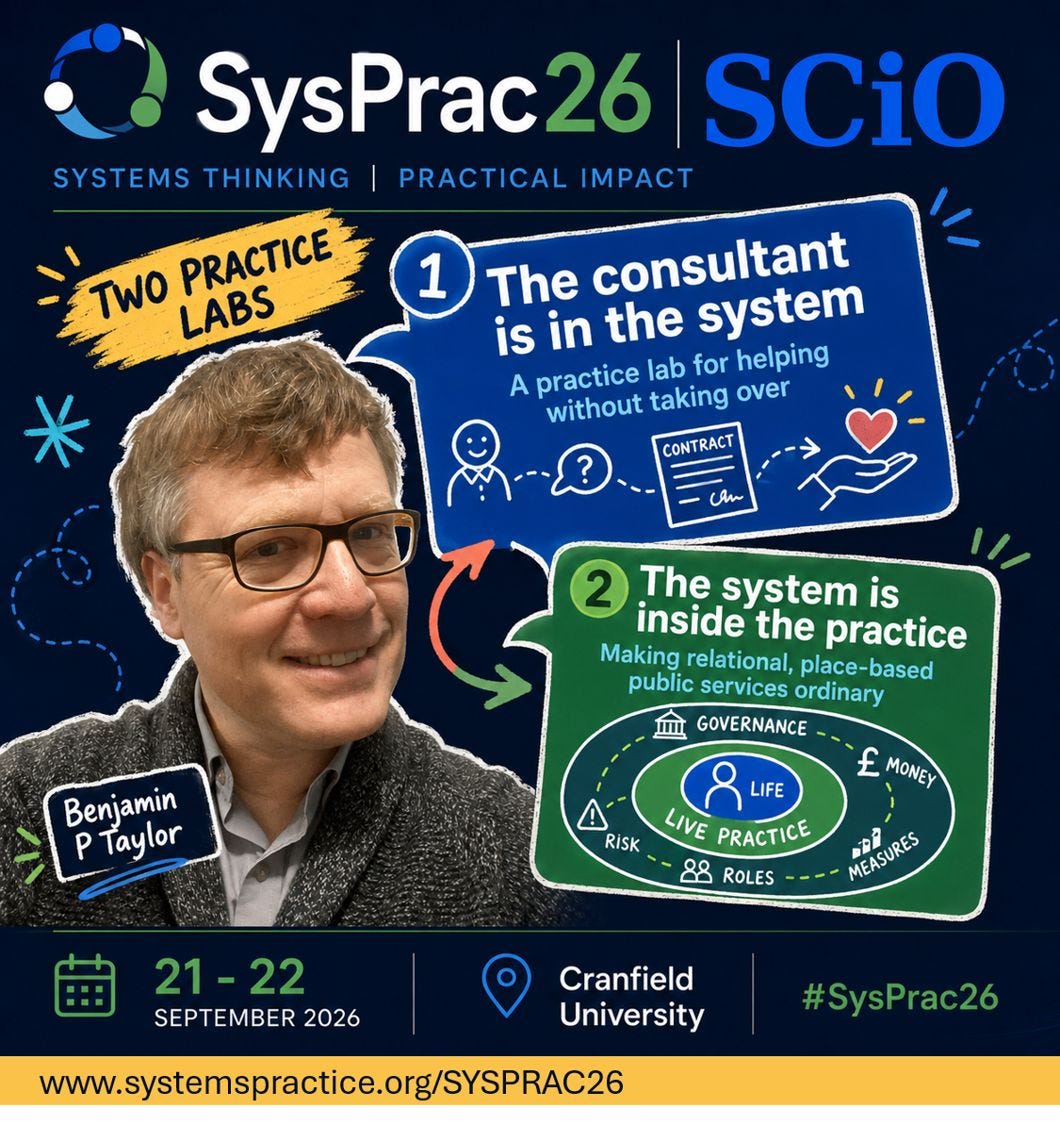
I’m doing two workshops at hashtag#SysPrac26; a slightly alarming pair (as the performance artist said to the episcopal authority figure)…
‘The consultant is in the system: a practice lab for helping without taking over’
‘The system is inside the practice: making relational, place-based public services ordinary’
There is no outside!
In the first workshop, we’ll look at what happens when we offer help.
Every question, diagnosis, suggestion, and contract shapes the situation. When things get awkward, consultants are easily pulled towards one of two positions: the expert who takes responsibility for solving the problem, or the servant who takes responsibility for doing what the client asks. Neither position leaves much responsibility with the client.
We’ll practise inquiry, contracting, reframing, authenticity, and working with resistance. We’ll look for the client behind the client, the problem behind the problem, and the patterns in the wider system which are turning up in the consulting relationship itself. hashtag#SystemsPractice
The second workshop begins from the other end.
hashtag#Relationalpublicservices and hashtag#placebasedpublicservices often produce good work in a protected space. People respond intelligently to lives rather than processing cases. But budgets, measures, assurance, professional boundaries, decision rights continue to organise around institutions.
The better the local workaround becomes, the easier it can be for the wider system to remain unchanged.
So we’ll work on the double task: changing what happens in people’s lives, while changing the conditions which decide whether that work is legitimate, resourced, and able to endure.
The connection between the workshops is stronger than I first realised. A consultant can’t stand outside the system being changed. And good practice can’t stand outside the institutional machinery which authorises, measures, and funds it. In both cases, the intervention is already entangled with the conditions it’s trying to change.
Neither session will be a presentation with some small-group exercises glued on – they’re practice labs. Bring a live, awkward situation and come prepared to do some work on it.
Join me: 21–22 September 2026, Cranfield University sign up at www.systemspractice.org/SYSPRAC26
(I’m hoping at least one person will attend both, and help me see the deeper links)
Which is harder: helping without taking over, or changing the conditions around good work without having that work absorbed by them?