
Join the full conversation on Linkedin: https://lnkd.in/p/eKXqTVcG
I joined The Association Of Directors of Public Health (UK)’s systems thinking workshop as part of SCiO – Systems and Complexity in Organisation to share our systems practice work. I supported breakouts on #neighbourhoodworking and the #viablesystemmodel.
I keep coming back to what people can actually do with the understanding we develop together.
Take neighbourhood working. People can agree that services should work together yet nobody in the partnership can change the rules that leave a resident doing the chasing. Establishing where that decision sits, getting someone to take responsibility, finding the time and resources to act are part of the work. So is discovering that the rule wasn’t the main obstacle after all.
‘Insight’ will soon be very accessible. We have good ways to produce plausible explanations, useful questions, and maps. SCiO will soon launch its systems practice thinktank, ‘the 42’, and like a lot of my own work these days, it’s supported by a bespoke LLM.
What does it take for those insights to change things in a place, when everybody returns to the pressures of day-to-day work?
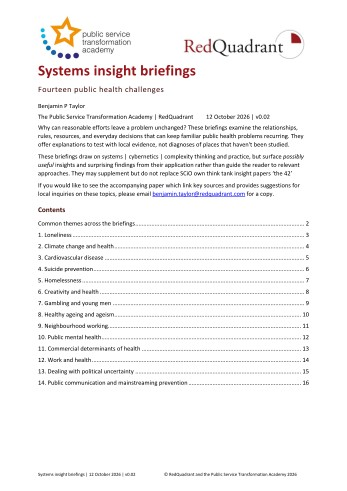
I’ve attached fourteen one-page systems insight briefings I developed through The Public Service Transformation Academy and RedQuadrant, covering public health challenges that impact us all. These are my own papers, separate from SCiO’s workshop materials.
They offer explanations to investigate, decisions to work on, counter-intuitive possible insights. If you want the accompanying paper with local inquiry suggestions and practical tests, just ask. They also ask what would show that an explanation is wrong. They aren’t diagnoses of places I haven’t studied, or instructions to apply irrespective of local circumstances – those, frankly, are all too common nowadays.
Implementation changes what we know. Trying to improve something exposes missing authority, hidden work, conflicting purposes, and sometimes the inadequacy of our original account. People need the capability and permission to keep learning and changing the arrangements themselves.
That’s the work I want these papers to support. Thanks to ADPH and my SCiO colleagues for the workshop, and to the directors of public health who brought their questions and experience. It’s important – these topics affect us all:
-Loneliness
-Climate change and health
-Cardiovascular disease
-Suicide prevention
-Homelessness
-Creativity and health
-Gambling and young men
-Healthy ageing and ageism
-Neighbourhood working
-Public mental health
-Commercial determinants of health
-Work and health
-Dealing with political uncertainty
-Public communication and mainstreaming prevention
I’d be interested to hear what you make of these briefings – are they interesting? Insightful? Would you like the local inquiry suggestions? More importantly, do they help to change anything? Does experience prove them wrong?
Do these papers resonate if you’re not in public health?

