
Join the debate on LinkedIn at https://www.linkedin.com/posts/antlerboy_what-if-empowerment-has-to-pass-through-grief-share-7487768478897270786-8vgE/
Bottom, Customer and Citizen Space — and the different sources of power available in each relationship.
What if empowerment has to pass through grief?
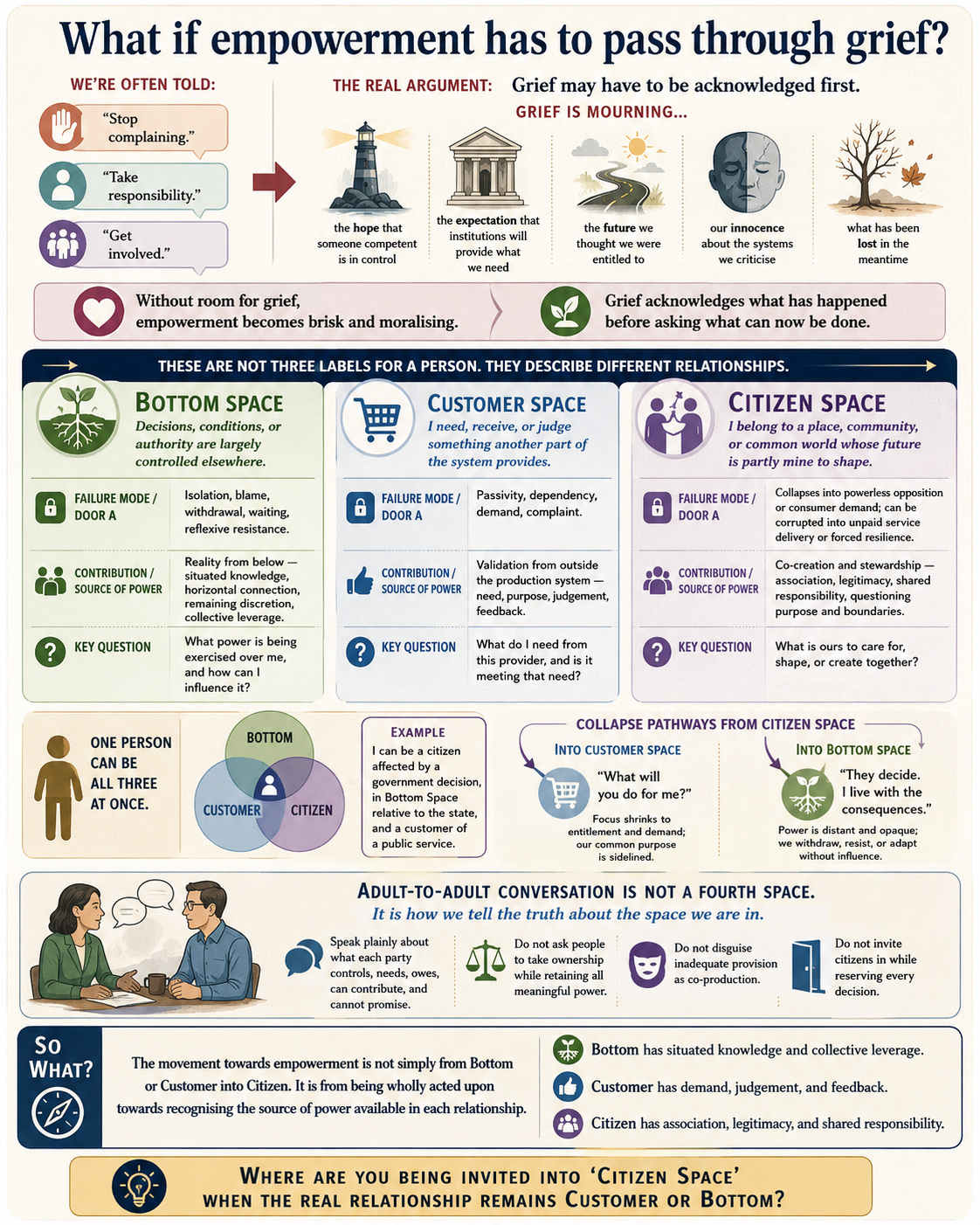
We often talk as though people can simply step out of powerlessness and into ‘Citizen Space’:
- Stop complaining.
- Take responsibility.
- Get involved.
But something may have to be mourned first.
- The hope that someone competent is in control.
- The expectation that institutions will provide what we need.
- The future we thought we were entitled to.
- Sometimes our innocence about our own part in the systems we criticise.
And, just… everything that’s been lost in the meantime.
Without room for that grief, empowerment becomes brisk and moralising. Real loss, and real powerlessness, are treated as faulty attitudes.
Grief acknowledges what has happened before asking what can now be done.
Grief before responsibility
Perhaps that’s the connection between grief and empowerment. Grief doesn’t magically take us out of relationships of dependence or unequal power. It may stop those relationships becoming our whole identity.
I can acknowledge what has been done to me without concluding that I am only powerless. I can acknowledge what has not been provided without becoming only a recipient or complainant. I can acknowledge what has been lost without pretending it can be restored – and then ask what remains possible with others.
Three relationships, not three kinds of person
This also helps clarify something I’ve struggled with in the distinction between Bottom, Customer and Citizen Space. The first two are part of Barry Oshry’s work; the third is a powerful extension by John Watters.
They aren’t three labels competing to describe a person; they describe different relationships:
- I am in Bottom Space when decisions, conditions, or authority are largely controlled elsewhere.
- I am in Customer Space when I need, receive, or judge something another part of the system provides.
- I am in Citizen Space when I belong to a place, community, or common world whose future is partly mine to shape.
The failure and the power in each space
They don’t sound very powerful, do they?! Each space has a familiar failure mode – what Oshry calls the ‘Door A’ response – and a more generative contribution.
- Bottom Space can collapse into isolation, blame, withdrawal, reflexive resistance or waiting for those with power to change.
But Bottoms also possess information that power cannot see. They can connect with one another, use the discretion and influence that remain, and turn shared experience into collective leverage. Their distinctive contribution is reality from below. - Customer Space can collapse into passivity and dependency, or into a relationship conducted entirely through demands and complaints.
But Customers can make need and purpose visible, offer honest judgement, challenge failure, and help a provider learn whether it is creating value.
Their distinctive contribution is validation from outside the production system. - Citizen Space can collapse into powerless opposition or consumer demand. It can also be corrupted into unpaid service delivery, forced resilience or institutions quietly handing their duties to ‘the community’.
But Citizens can build relationships and collective capacity, care for shared goods, participate in decisions, create new possibilities, and question the system’s boundaries, authority and purpose. Their distinctive contribution is co-creation and stewardship.
Empowerment isn’t a move into Citizen Space
The movement towards empowerment is therefore not necessarily from Bottom or Customer into Citizen. It is from being wholly acted upon towards recognising the particular source of power available in each relationship.
- Bottom has situated knowledge and collective leverage.
- Customer has demand, judgement and feedback.
- Citizen has association, legitimacy and shared responsibility.
- And ‘the system’ depends entirely on all three of them.
One person, three relationships
So, I can be all three at once:
- a citizen affected by a government decision
- in Bottom Space relative to the state
- and a customer of a particular public service
How Citizen Space collapses
The challenge is that Citizen Space readily collapses into one of the other two:
- into Customer Space when shared authorship becomes: ‘What will you do for me?’
- into Bottom Space when real differences in power become: ‘They decide. I live with the consequences.’
Citizen Space doesn’t deny need or unequal power. It says: ‘This affects me. I am part of it. I have some capacity and responsibility to act with others.’
That isn’t the same as institutions handing their duties to ‘the community’! Nor is inviting people to ‘co-create’ meaningful if the decision has already been made and what is really wanted is consent, unpaid delivery, or better-behaved customers.
Which conversation are we actually having?
Perhaps the point is to ask which conversation we are actually having. Before trying to empower anyone – including yourself – identify the relationship.
- What power is being exercised over me, and how can I influence it?
- What do I need from this provider, and is it meeting that need?
- What is ours to care for, shape or create together?
Often, all three are present. It’s empowering if we can name them separately rather than smuggling one into the language of another. And we may need to pass through grief first.
Adult-to-adult means telling the truth about power
That may also be what an adult-to-adult conversation requires: not pretending that power, capability or responsibility are equal; speaking plainly about what each party controls, needs, owes, can contribute, and cannot promise. That means surfacing the realities of power-over, power-to, power-with, and power-among. Adult-to-adult conversation isn’t another ‘space’. It’s how we tell the truth about the space we are in.
What institutions must do differently
It means that an institution doesn’t ask people to ‘take ownership’ while retaining all meaningful power.
- When people are in Bottom Space, it acknowledges the asymmetry, makes routes of influence real, and listens to what can only be seen from below – knowing how vital and valuable that is. It doesn’t disguise inadequate provision as co-production.
- Wehn people are Customers, it is clear about rights, standards and accountability, and learns from whether the service actually meets their needs.
- When people are invited in to Citizen Space while reserving every decision for itself. If shared authorship is intended, that requires some actual authorship: relationships, resources, room for initiative, meaningful decisions and the possibility that citizens may challenge what the institution thinks the purpose is.
The distinctions matter because asking a Bottom to behave like a satisfied Customer, asking a Customer to shoulder the obligations of a Citizen, or calling someone a Citizen while treating them as a powerless Bottom are all ways institutions can evade their own responsibilities.
What remains ours to do together?
Grief may be part of what allows us to see those responsibilities clearly.
It gives us room to acknowledge what has been lost, what cannot be restored and where power really lies – before deciding what is still ours to do together.
Where are you being invited into ‘Citizen Space’ when the real relationship remains Customer or Bottom?


One thought on “What empowerment asks us to grieve”