
Join the conversation on LinkedIn https://www.linkedin.com/posts/antlerboy_epistemological-closure-im-writing-about-share-7495375130819338240-988V/
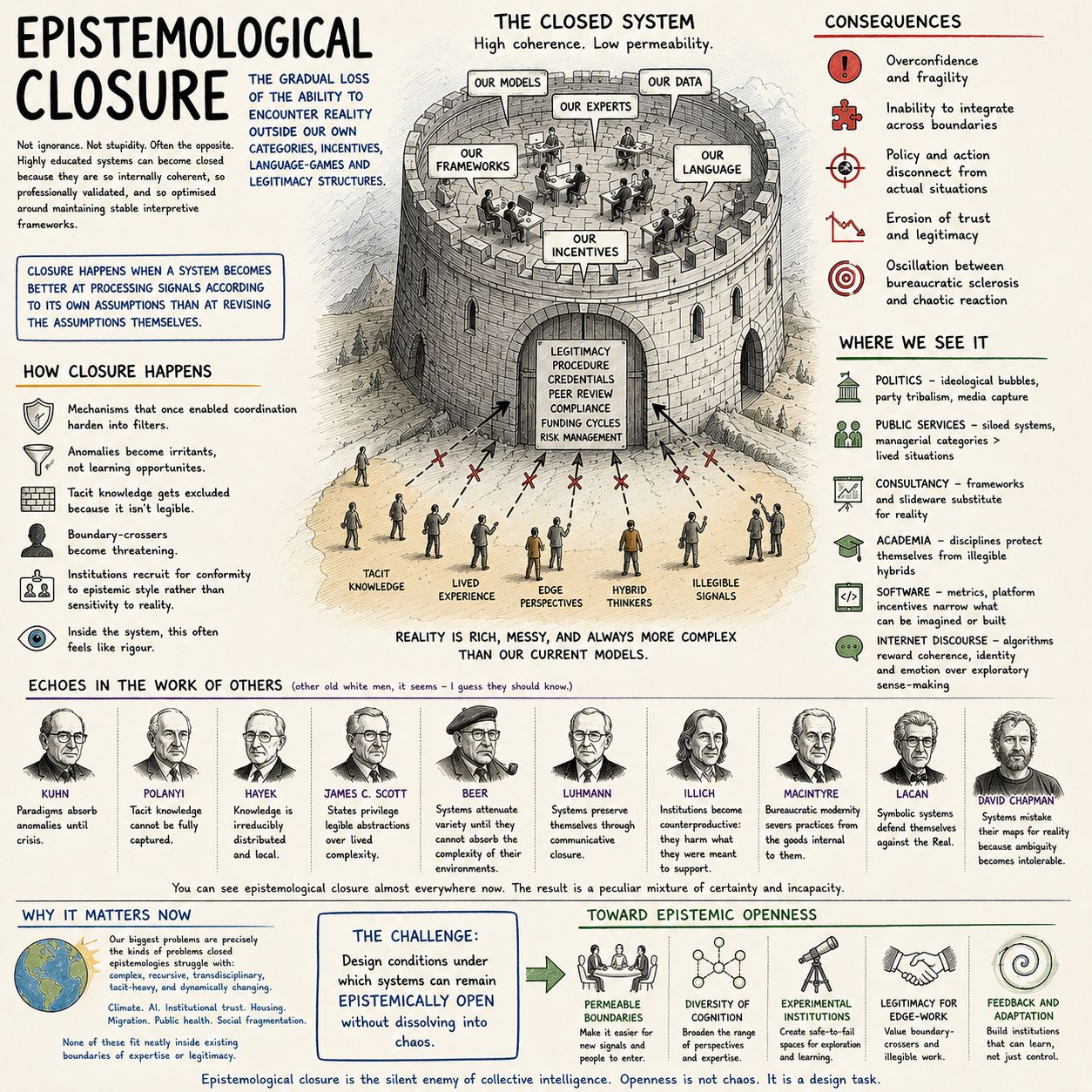
‘Epistemological closure’. I’m writing about it a lot, and I see a lot of it around – I think LLMs often help people see it! It’s the process through which a person, institution, or society loses the ability to encounter reality outside its own categories, incentives, language-games, legitimacy structures. What Boyd called ‘locked orietation’.
Highly-educated systems can become epistemologically closed precisely because they are so internally coherent, so professionally validated, so optimised around maintaining stable interpretive frameworks. Closure happens when a system’s ability to process signals according to its own assumptions outweighs it’s ability to revise those assumptions. Anomalies become irritants, not learning opportunities. Tacit, illegible knowledge is excluded. Boundary-crossers are a threat. Institutions recruit for conformity to epistemic style rather than sensitivity to reality. This often feels, on the inside, like rigour. And it’s needed to some extent for institutional/social reproduction.
Versions of this idea are all over. Kuhn paradigms absorbing anomalies until crisis is unavoidable. Polanyi saw tacit knowledge formal systems can’t fully capture. Hayek saw that knowledge is irreducibly distributed and local. Scott showed states privilege legible abstractions over lived complexity. Beer described institutions attenuating variety until they can’t absorb the complexity of their environments. Luhmann argued systems sustain via communicative closure. Illich saw schools harming learning, medicine harming health, transport destroying mobility. MacIntyre described bureaucratic modernity severing practices from the goods internal to them. Lacan understood how symbolic systems defend themselves against encounters with the Real. Chapman writes that systems mistake their maps for reality because ambiguity and unformalised pattern become intolerable.
You can see it almost everywhere now. Political parties increasingly can’t perceive realities outside media-conditioned ideological frames. Public service categories often displace lived situations. Consultants substitute frameworks and slideware for contact with operational reality. Academic disciplines, software, internet discoure with alogrithmic capture. The emperor has no clothes.
It’s a weird mixture of certainty and incapacity: overconifdence matched by inability to act effectively in the ‘real world’.
The real problems we face are the type where closed epistemologies fail: complex, recursive, transdisciplinary, tacit-heavy, dynamically changing. Climate, AI, institutional trust, housing, migration, public health, social fragmentation. None fit inside existing boundaries of expertise or legitimacy.
The challenge is designing conditions under which systems can remain epistemically open without dissolving into chaos. What do you think?
(Image courtesy ChatGPT – I love that it can’t properly distinguish or differentiate all the old white men on which I draw…)

