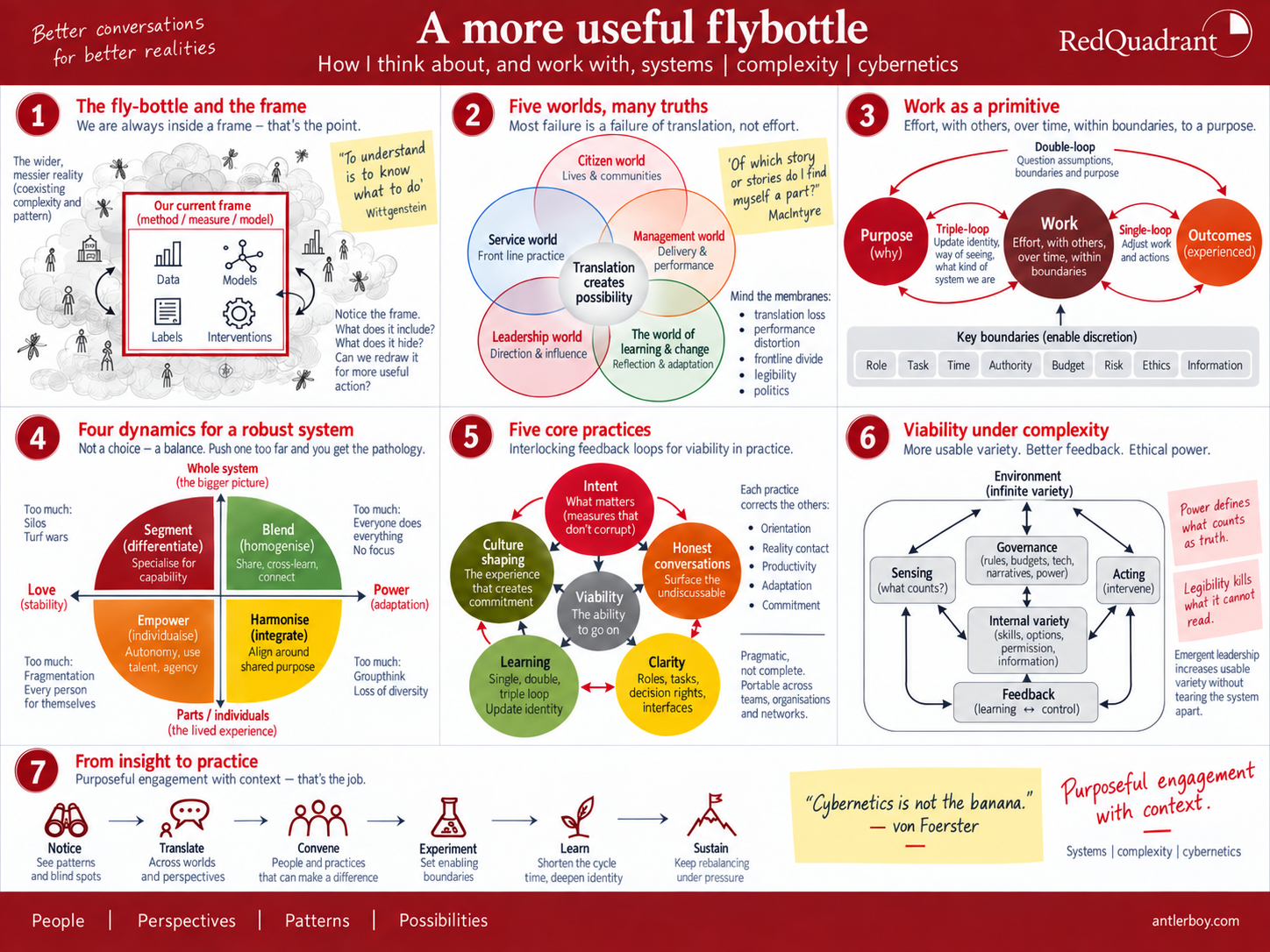

Some time ago, I was challenged to do this with the ‘six diagrams’ constraint…
For me, it’s all about purposeful engagement with context. We need enough shared understanding to act purposefully with others, while remaining able to question how we understand the situation.
A ‘team’, a ‘service’, or a ‘problem’ is already a way of carving things up. These distinctions help us make sense and organise work, but also shape what becomes invisible or undiscussable. We inherit frames as well as making them. We are inside the fly-bottle, including when we think we’re explaining it.
The world contains both infinite nebulosity and unending pattern. There are regularities we can investigate rigorously, and ambiguity that doesn’t disappear when we draw a diagram. The field’s methods and laws help us test our understanding.
People also have purposes of their own, and our interventions have consequences beyond the boundaries we’ve chosen.
In public services, I use five worlds: citizen, service, management, leadership, and learning and change. Each brings different pressures and ways of recognising value. An organisation can meet its measures while making people’s lives harder. Translation across these worlds is practical work, including discovering where we disagree; it doesn’t require everyone to ‘acquire the same worldview’.
‘Work’ is effort with others, using judgement and discretion, within boundaries, over time, towards a purpose. Those boundaries can protect discretion or extinguish it.
Outcomes arise from much wider interactions, so feedback must reach beyond performance: changing how we work, questioning purposes and assumptions, and reconsidering our identity and role. Those are the three learning loops I use.
I work with five core practices:
– Constructive conversations surface reasoning and the undiscussable.
– Clarity makes relationships, roles, tasks, and decisions workable. Learning tests our understanding.
– Culture shaping attends to how people’s experience develops commitment or withdrawal.
– Intent keeps purpose and measures connected to what matters.
Each practice needs feedback from the others.
Alongside them, I use four dynamics, drawing on Oshry and Beer:
– segment to develop specialised capability
– blend to share across groups
– empower individual agency
– harmonise around shared purpose
All four need attention, at different scales. More integration isn’t always better; sometimes a dissenting voice needs room.
Power runs through this: who defines the problem, whose knowledge counts, who can act, and who lives with the consequences. My commitment is to create conditions for human freedom and agency, and to take responsibility for effects I can’t fully control.
These ideas help me work across different languages and methods. They don’t give me a complete meta-language or a position outside the situation. My own framing has to remain open to challenge, especially when it appears to be working.
What’s your equivalent? And what am I missing?


3 thoughts on “A more useful fly-bottle – systems | cybernetics | complexity in six diagrams”