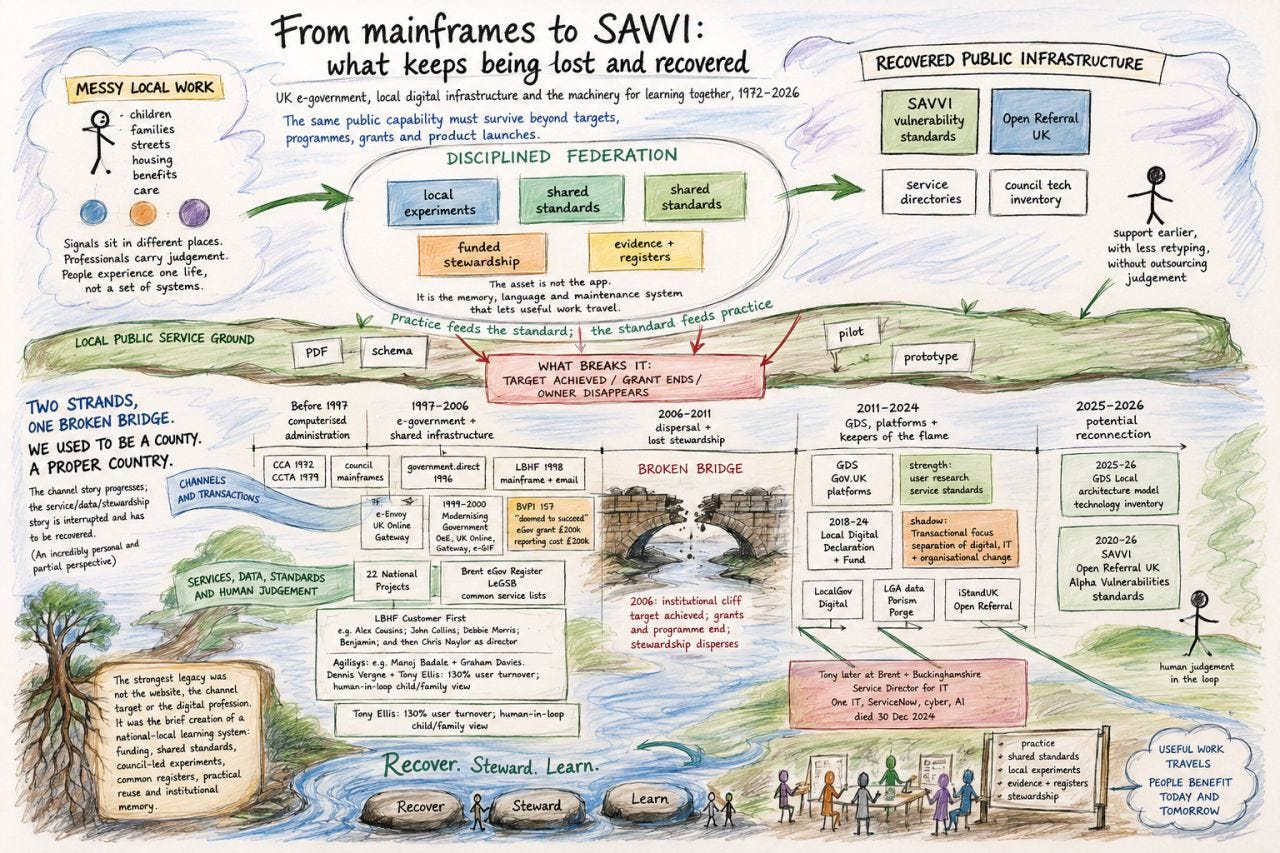

From mainframes and BVPI 157 to SAVVI, Open Referral UK and the unfinished business of local digital government
Join the debate on LinkedIn https://www.linkedin.com/posts/antlerboy_localgovernment-datastandards-publicservicetransformation-share-7488562400292671488-9s2A/
___
‘We can’t, we don’t know how to do it any more’
When I joined Hammersmith & Fulham in 1998, the council ran on a mainframe. We introduced internet email that year (and I borked it: different story)…
2003-04 I was eGovernment Manager, dealing with BVPI 157: make every suitable service ‘available electronically’ by the end of 2005.
A classic: doomed to succeed, demanding gaming.
A transaction could be ‘e-enabled’ (even by phone or fax!) while the service, hand-offs and failure demand behind it remained untouched.
I calculated for ODPM that collecting and reporting the data cost £200,000; the same as our eGov grant.
A small, perfect tragedy of target-based reform: spending money to make a narrow definition of success legible.
BUT the best of that period wasn’t the target. It was the learning machinery it: 22 council-led National Projects, common standards, the Brent eGovernment Register, funding for experiments and an expectation that useful work would spread.
At H&F, Alex Cousins assembled a cross-council Customer First team – me, John Collins from Council Tax, Debbie Morris from Enviroment. Agilisys’s Manoj Badale and Graham Davies worked with us on the strategy as part of the ‘strategic partnership’.
Dennis Vergne, Chris Naylor and many others turned that strategy into Residents Direct, Smarter Borough, and Community Support: different operating models for different work, rather than one contact centre treating every need as a transaction.
I want to mention Tony Ellis in this history too. Faced with 130% user turnover on the Children’s Services IT system, he didn’t reach first for more training or tighter compliance. He developed a quality-improving, human-in-the-loop view of children and families: data supporting professional attention and judgement, not replacing it.
Tony later helped Buckinghamshire establish the unitary council’s systems, pandemic working, cyber-security and practical AI. He died unexpectedly in December 2024, far too early.
Then, much of the wider e-government system was dispersed.
GDS later did exceptional work. It also helped make ‘digital’ a separate profession, often focused on selectable transactions and detached from IT, operations, data and organisational change.
The embers survived through the likes of the LGA’s data work, LeGSB, iStandUK, Open Data UK, Porism, Porge, LocalGov Digital.
Now some threads may be reconnecting.
The Data Standards Authority has published Alpha Vulnerabilities Data Standards developed through SAVVI and iStandUK. iStandUK is also convening councils around national data sources for local service directories.
Unglamorous plumbing – but serious work on making information make a difference in people’s lives.
Which shared public infrastructure have we already invented, forgotten – and now need to recover?
Two practical invitations to contribute are in the first comment.
#LocalGovernment #DataStandards #PublicServiceTransformation
 chosen path