
(rewiring for local relationality 2/3)
Join the debate on linkedin at
https://lnkd.in/p/ecDP6wCJ
Relational public services are no longer short of advocates. What they’re missing is an account of why they collapse.
We keep showing the attractive picture. The walls are down. People work across boundaries. Staff use judgement. Citizens are encountered as people rather than cases. Help is earlier, more human and often less expensive. Then, months or years later, the walls return.
The usual explanation is that risk-averse leaders, bureaucratic managers, or an old culture blocked the better way. That’s inadequate.
The walls were built to do work. They ration finite resources. They assign statutory and professional responsibility. They make decisions auditable. They contain financial and political risk. They protect some forms of consistency and equity.
They also split lives into categories, suppress judgement, generate hand-offs and create failure demand. Both things are true.
A relational pilot can remove the walls locally because trusted people carry the risk. It may have a committed sponsor, informal permission, and temporary money and freedom from ordinary measures.
That can produce excellent work. It isn’t, yet, a new public-service model. It is a temporary suspension of parts of the existing one.
When pressure returns, the system asks: who authorised this? Who owns the risk? Which budget benefits? How do we know it is fair? How do we hold it to account?
Without answers, the old arrangements also return. Not necessarily because people reject the results, but because the experiment never replaced the functions those arrangements performed.
Every serious proposal for relational public services therefore needs an account of sustainment.
Who can decide at the point of knowledge? What capability can they draw on? How will judgement remain visible without being strangled? How will rights and equity be protected? Where will financial risk sit? What survives when the founding leader leaves?
It is irresponsible to advocate for relational public services without an account of why the surrounding system repeatedly rebuilds the walls.
Bring them down where they cause harm. Understand why they were built. Design how their necessary work will be done differently.
Otherwise they will return.
A fuller post on this is on my blog – link in comments.
#relationalpublicservices #publicservices #systemschange
Have you seen this happen?
The walls come back
Relational pilots repeatedly show what better public services can look like. The harder work is replacing the functions performed by the rules and boundaries they suspend, so that the host system does not simply recreate them under pressure.
A relational model is not sustainable until the surrounding system changes what it funds, counts, authorises and protects.
Benjamin Taylor • August 2026
| The claim It is irresponsible to advocate for relational public services without an account of why the surrounding system repeatedly rebuilds the walls. |
Relational services aren’t short of proof
Public services are full of people trying to help other people. And most are organised around services, departments, thresholds, statutory duties, budgets, eligibility rules, measures, professional roles, risk systems, and lines of accountability. All of those have functions. None of them is the same thing as the life being lived.
Relational public services start from that life. They listen for purpose rather than forcing a situation immediately into a service category. They use judgement. They build trust and agency. They coordinate around a person rather than expecting the person to coordinate the system. Done well, this can improve outcomes, reduce failure demand and make work more humane.
We have enough examples to know that this can work. The real question is why it so often remains exceptional.
The recurring pattern is recognisable. A small team gets permission to work differently. It succeeds. People involved become enthusiastic. Leaders ask whether it can be scaled, evidenced, governed and made safe. The pioneers explain that judgement, trust, context and relationship are part of the method. The organisation hears ambiguity and exposure. The work either collapses, becomes a protected subculture, is translated back into ordinary process, or survives as a heroic exception.
Months or years later, much of the old machinery is back. The people who held the exception together have left, burnt out or become permanent translators between two incompatible operating systems. The organisation concludes that the model was hard to scale. Often the experiment worked. The host system did not change.
Why the walls were built
The easy account says that bureaucracy, risk aversion or bad management defeated a better way. That is too convenient for relational advocates.
The walls do work. They ration finite resources. They make rights and eligibility visible. They allocate professional and statutory responsibility. They create repeatability. They protect some forms of equity. They make spending and decisions legible to people who are distant from the work. They contain political, financial and safeguarding risk. They give somebody a route to challenge a decision.
They also split people’s lives into categories, suppress useful discretion, reward hand-offs, create queues, and hide costs that end up elsewhere. Both are true.
A relational pilot can remove some of those constraints locally because a sponsor, project leader or unusually trusted team absorbs their functions informally. Someone gives permission. Someone carries reputational risk. A budget is bent. A performance measure is ignored. Staff know who to call. Senior people defend the work when it produces an awkward exception.
That’s why the pilot can feel liberated. It is also why it is fragile. The organisation has suspended some of its usual control mechanisms without yet replacing the necessary work those mechanisms were doing.
A serious relational model has to answer the questions the bureaucracy was answering, including the questions it answered badly: who decides, who pays, who is entitled, who carries risk, how do we know, what happens when people disagree, what stops arbitrariness, and who can intervene when something goes wrong?
The double bind
The central operating contradiction is simple. Public services ask for relational work while still accounting for transactional delivery.
They ask for collective leadership and hold individuals to account. They ask people to work across boundaries and measure performance inside silos. They ask professionals to use judgement and punish ambiguity. They ask managers to invest in prevention and make them defend this year’s budget. They praise community capacity while treating it as a delivery channel or free labour. They ask for trust while retaining systems designed around mistrust.
People respond rationally. Full refusal is risky. Full commitment is also risky. So systems produce activity that looks like progress while limiting exposure: discovery, scoping, workshops, governance groups, pilots, option appraisals, benefits frameworks and requests for more evidence. Some of that is useful. Inside the bind, it can become shelter.
The sentence that needs to become discussable is: ‘We are asking for collective, relational action while exposing people to individual blame.’
Trust is not a mood that leadership can request. It is partly a property of the conditions people work in. If authority, accounting, measures and consequences remain hostile to interdependence, exhortations to collaborate become another demand placed on people who cannot safely comply.
Relational is not the opposite of transactional
There is another trap. Once people have seen what relational work can do, it is tempting to turn ‘relational’ into the good category and ‘transactional’ into the bad one.
That does not describe a competent state. Paying the right benefit, registering a birth, collecting waste, issuing a licence, giving a clear entitlement and making a lawful decision can all be excellent transactions. People often want speed, predictability, anonymity and equal treatment. A forced relationship can be intrusive as well as wasteful.
The question is fit. Standardise when you can. Personalise when you must. Use relationship where context, instability, trust, judgement or interdependence make it necessary. Use clean transactions where the need is clear and variation adds no value.
The practical problem is that the operating system tends to prefer what is legible from above. Complex situations are translated into categories that fit funding, professions and pathways. Relational workers then compensate for the information that was lost. If the surrounding rules never learn from that work, the maze remains and the navigator becomes part of its permanent cost.
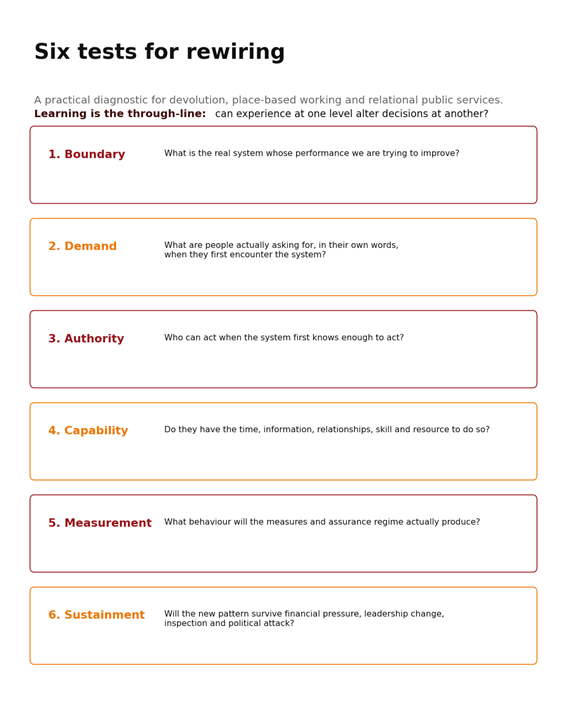
Six tests before calling a model sustainable
A relational service is not sustainable because it has a good team, strong outcomes or a supportive director. Test the surrounding system.
Boundary. What is the real system whose performance is being improved: an organisation, a pathway, a place, a neighbourhood, or the person’s life? If leaders say ‘whole person’ while budget and accountability stop at the organisational boundary, the contradiction will return.
Demand. What are people actually asking for at first contact, in their own words? If the system only sees coded service demand, it cannot learn where its own processes, thresholds and failures are creating work.
Authority. Who can act when the system first knows enough to act? If the least authorised people are placed at the most important sensing points, relationality will degrade into triage, referral and escalation.
Capability. Authority without skill, time, data, relationships and access to resource is abandonment. Capability without authority is decorative. The people expected to respond to variation need both.
Measurement. What behaviour do the measures produce? If staff are rewarded for throughput, referral, short contact, service-specific savings or a narrow acute outcome, those measures will eventually dominate the relational purpose.
Sustainment. What happens when the founder leaves, finance tightens, an inspection goes badly or a political controversy lands? A viable model has a budget, governance, delegated authority, workforce arrangements, information, interfaces and leaders who can explain its trade-offs in public.
What responsible advocacy requires
It is irresponsible to advocate for relational public services without an account of why the surrounding system repeatedly rebuilds the walls.
That does not mean accepting the walls as they are. It means understanding the work they perform, distinguishing necessary protections from inherited habits, and designing better ways of carrying the necessary functions.
A relational movement should therefore spend less time proving that relationships matter and more time altering the host system. Move useful authority towards the point of knowledge. Give that authority capability. Put dependencies into the accounting rather than hiding them. Change measures before demanding different behaviour. Protect rights without assuming uniform process. Let citizen contact become a source of intelligence. Give community actors power and resource rather than praise alone. Create ways for local learning to change central rules.
The transfer object is not the pilot. It is the conditions that let people exercise good judgement without becoming heroic exceptions.
That is also a more respectful stance towards managers and political leaders. Most are not ignorant of the failures around them. They are carrying statutory duties, budget pressure, inspection, media risk, workforce fragility and vertical accountabilities. A reform that asks them simply to stop controlling is unlikely to survive. They need a different way to obtain assurance, allocate risk and know when intervention is necessary.
Bring down the walls that cause harm. Keep or redesign the functions that protect rights, equity and accountability. Build learning into the control system so that the next version can change as reality changes.
Otherwise the walls will return, and another successful experiment will be remembered as something that ‘worked there’ rather than as evidence that the state itself needed to change.
The six tests also work as a sustainment diagnostic for relational public services.
 chosen path
superb
LikeLiked by 1 person